




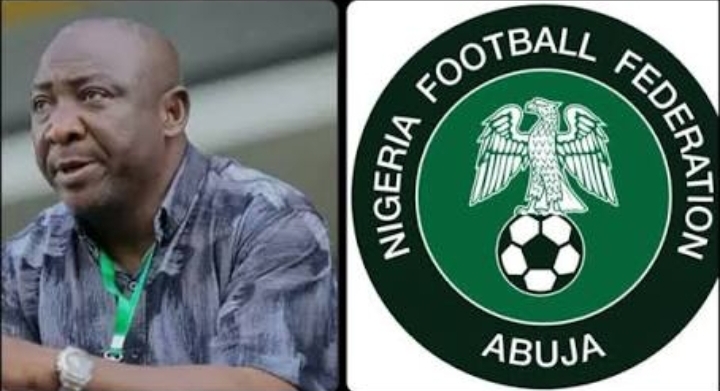
The President of the Nigeria Football Federation, Ibrahim Musa Gusau, has resigned from his position amid mounting pressure over the state of Nigerian football and a series of setbacks suffered by the country’s national teams.
Gusau announced his resignation at a press conference in Abuja on Thursday, ending his tenure as head of the country’s football governing body before the expiration of his four-year mandate. He was elected NFF president at the federation’s 78th Elective Congress in September 2022.
The development has thrown the federation into a fresh leadership crisis and raised questions over the NFF’s planned Elective Congress scheduled to hold in Lafia, Nasarawa State, on September 27.
The NFF had earlier shifted the election from September 26 to September 27 to accommodate the Super Eagles’ 2027 Africa Cup of Nations qualifying match against Madagascar. The congress is expected to elect members of the federation’s Executive Committee for the next four years.
Gusau’s resignation comes after weeks of growing criticism of his administration, following disappointing performances by several Nigerian national teams.
Pressure intensified after the Super Falcons failed to secure qualification for the 2027 FIFA Women’s World Cup, while the Super Eagles also missed out on qualification for the 2026 FIFA World Cup.
The NFF had earlier publicly acknowledged the disappointment caused by the Super Falcons’ setback, saying the federation accepted responsibility for the outcome.
“We hear the disappointment of Nigerians, we share it and we accept our responsibility,” the federation said in a statement issued earlier this month.
The NFF also pledged to conduct “an honest assessment of our preparation, technical planning, logistics and overall operations” as part of efforts to address the challenges confronting Nigerian football.
Reports on Thursday indicated that Gusau’s resignation could be followed by further changes within the NFF leadership, with several members of the federation’s Executive Committee also said to have stepped down.
Although details of the transition are still emerging, the resignations could have significant implications for the planned September 27 elective congress and the administration of Nigerian football.
The NFF’s electoral statutes provide that when more than half of the positions on the Executive Committee become vacant, the General Secretary is required to convene an Extraordinary Congress, while the remaining members are expected to manage the federation’s daily affairs pending new elections.
Before his resignation, Gusau’s administration had also come under intense public scrutiny following calls for reforms and an investigation into issues surrounding the management and governance of Nigerian football.
The immediate focus is now expected to shift to the NFF Congress, the National Sports Commission and other football stakeholders as they determine the next steps for the federation and whether the September election can proceed as scheduled.
Gusau’s departure marks one of the most significant leadership developments in Nigerian football in recent years, coming at a period of widespread calls for a comprehensive restructuring of the country’s football administration.