






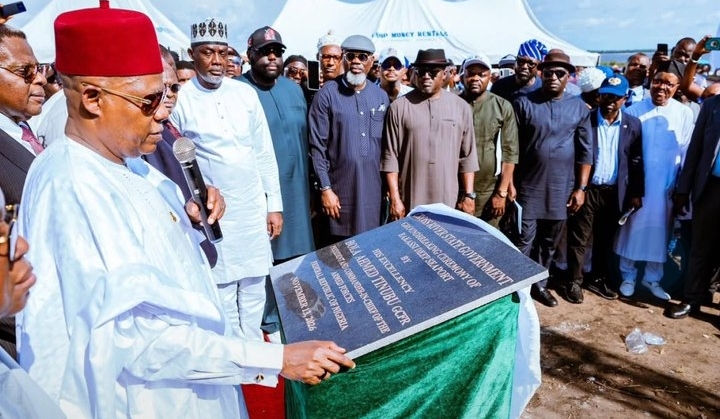
President Bola Tinubu has flagged off the construction of the $3.5bn Bakassi Deep Seaport in Cross River State, ending years of uncertainty surrounding the long-awaited project and renewing efforts to decentralise Nigeria’s maritime economy.
The project, which is expected to position Nigeria as a major maritime and trade hub in West and Central Africa, is also projected to help the country generate up to $44bn annually from its blue economy by attracting cargo traffic currently handled by neighbouring countries.
Tinubu, represented by Vice-President Kashim Shettima, performed the groundbreaking ceremony in Bakassi on Friday, describing the development as a major step towards economic diversification and the exploitation of Nigeria’s maritime resources.
The President also dismissed allegations that political interests in Lagos, the South-West and Abuja had frustrated attempts to establish functional seaports outside Lagos.
According to him, the Bakassi project demonstrates the Federal Government’s commitment to developing multiple maritime gateways rather than concentrating the country’s international trade activities in one location.
“There is a rumour I hear in some corners that the West, Lagos, or Abuja never wanted a port to work anywhere outside Lagos. If that were true, would I be standing here today with a shovel in my hand?” he said.
Tinubu maintained that Lagos should be regarded as a partner in national maritime development rather than a competitor, warning that excessive dependence on one port location could undermine economic efficiency.
“Lagos is not our enemy. Lagos is our elder brother in trade. No country eats with one hand. No country carries all its loads on one shoulder; that shoulder will break,” he added.
The President said more than 80 per cent of Nigeria’s foreign trade currently passes through Lagos, contributing to congestion, delays and increased costs.
He explained that the Bakassi facility, designed with a 20-metre draft to accommodate large vessels, would provide an alternative maritime gateway and strengthen Nigeria’s capacity to compete for regional cargo traffic.
The project is also expected to be supported by a 260-kilometre superhighway that will facilitate the movement of goods from the port to markets across the country.
Tinubu described the development as more than a Cross River project, insisting that its economic benefits would extend to other parts of Nigeria.
“This is beyond a Cross River dream. It is a Nigerian project. It is a poverty breaker,” he said.
The President urged residents and stakeholders to protect the project from political interference and support its successful implementation.
Meanwhile, Shettima has challenged African governments, particularly subnational administrations, to translate their economic advantages into concrete investments, industrial development and employment opportunities.
The Vice-President gave the charge while declaring open the sixth African Sub-Sovereign Governments Network (AfSNET) Investment Conference in Calabar, Cross River State.
According to him, economic development must be driven by states and regions, where infrastructure, agriculture, manufacturing and businesses directly influence people’s livelihoods.
“Our states and regions are not merely administrative units. They are economic actors, investment destinations, production centres and critical gateways to regional and continental markets,” Shettima said.
He disclosed that the investment pipeline presented at the conference contained 134 opportunities across 14 sectors, with an estimated value of $9.5bn.
The opportunities, he said, covered critical sectors of the economy, including agriculture, energy, digital technology, healthcare, tourism, manufacturing and infrastructure.
However, Shettima warned that announcing investment opportunities without ensuring their implementation would not deliver the desired economic transformation.
“The imperative before us is to move from investment potential to investment execution,” he stated.
He urged participating governments to develop bankable projects supported by credible feasibility studies, transparent governance, clear regulatory frameworks and appropriate financing arrangements.
The Vice-President also called for stronger partnerships between governments, financial institutions and private investors, noting that the success of the conference should be measured by completed projects, expanded businesses and jobs created.
Earlier, Cross River State Governor, Bassey Otu, described the groundbreaking as a historic achievement after years of political, administrative, legal and environmental challenges stalled the project.
He commended Tinubu for supporting the initiative and helping the state secure the necessary federal approvals.
The Minister of Marine and Blue Economy, Adegboyega Oyetola, also described the seaport as a significant milestone in Nigeria’s maritime development, economic diversification and regional competitiveness.
Similarly, the Managing Director of the Nigerian Ports Authority, Abubakar Dantsoho, said the facility would strengthen trade connections with landlocked African countries, including Chad, Niger, Mali and Burkina Faso.
He noted that the port, alongside its proposed road infrastructure, would position Nigeria as a preferred maritime gateway for markets across West and Central Africa.
The President of the African Export-Import Bank, George Elombi, represented by the bank’s Executive Vice-President for Intra-African Trade and Export Development, Kanayo Awani, said the project would strengthen regional trade and support the implementation of the African Continental Free Trade Area.
The Bakassi Deep Seaport project was conceived in 2014, with its environmental and social impact assessment developed in March 2015. Its implementation is expected to boost shipping, logistics, fishing, tourism, manufacturing and other maritime-related businesses.
The project is being developed under a public-private partnership arrangement with financing support from Afreximbank.




