






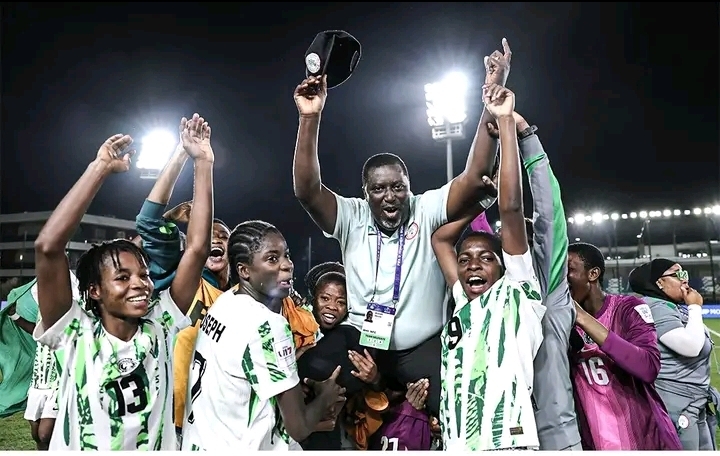
The Director-General of the National Institute for Sports, Philip Shaibu, has defended President Bola Tinubu’s support for Nigeria’s victorious Under-17 women’s team, the Flamingos, saying the President’s personal calls to the players during difficult moments in their campaign were more valuable than a post-victory appearance at the airport.
Shaibu also criticised former Anambra State governor and Nigeria Democratic Congress presidential candidate, Peter Obi, over the controversy surrounding his alleged attempt to welcome the team at the Nnamdi Azikiwe International Airport, Abuja, describing such an appearance as unnecessary.
Speaking on Tuesday during an interview on Channels Television’s Morning Brief, the former Edo State deputy governor said Obi could have simply stood at the airport and waved at the players like any other Nigerians rather than making the incident a subject of public controversy.
“Mr Obi can stand at the airport and wave to them like every other person did,” Shaibu said.
He argued that the real measure of leadership support for athletes was the encouragement and attention they received before and during competitions, particularly when their morale was low, rather than public celebrations after winning.
According to him, Tinubu personally contacted the Flamingos at different stages of the tournament, including when they needed encouragement following difficult moments.
“I consistently tell Nigerians, the President makes personal calls before, during, and after. And those calls are more important than after the victory,” he said.
Shaibu added that hearing directly from the President during challenging periods could boost the confidence of young athletes and motivate them to perform better.
“Because when the spirit is down and you get a call from the President telling you, look, forget about the last match, focus on the next match, I think that is more important than after winning coming to do a popularity show of showing affection,” he stated.
The NIS boss acknowledged that the Flamingos deserved a befitting reception following their historic achievement but insisted that the investment, preparation and encouragement behind their success should receive greater attention.
“These girls deserve to be received, these girls deserve all the accolade that they need. But what is key is the foundation preparatory to that victory,” he added.
Drawing from his experience as a former footballer and former deputy governor responsible for sports in Edo State, Shaibu described the President’s direct engagement with athletes as an uncommon but significant gesture.
He recalled that getting state governors to communicate with players in their dressing rooms was sometimes difficult, contrasting that experience with what he described as Tinubu’s willingness to personally speak with the young footballers.
“To get a governor to even speak to players in the dressing room was difficult. And here you are not even compelling or appealing or begging the President to make a call. He’s on his own. Says, ‘I want to talk to the girls. How are they doing? Fine. I want to talk to them,'” he said.
He explained that such communication could have a lasting psychological impact on players, particularly young athletes representing the country on the international stage.
“You are in a dressing room and you are hearing from your President talking to you. That, for me, is more important. That’s what the President does,” Shaibu added.
On whether officials of the Nigeria Football Federation were right to prevent Obi from greeting the team, Shaibu said sporting delegations sometimes operate under specific instructions restricting players’ interactions while travelling.
He cited an experience involving Enyimba players whom he encountered at an airport, explaining that he merely waved at them after being informed they were travelling.
Shaibu said such protocols should be respected, noting that teams could have different arrangements for managing interactions with players depending on the circumstances.
The controversy erupted after Obi alleged that NFF officials prevented him from greeting the Flamingos when they returned to Abuja on Monday following their triumph at the 2026 FIFA U-17 Women’s World Cup in Morocco.
Obi said he arrived at the airport around 7am to catch a flight to Enugu and asked his protocol officer, Jackie Wayas, to establish whether he could meet the returning players.
He alleged that he was informed that the officials had rejected his request and threatened to sanction those who allowed him access to the team.
However, Chairman of the National Sports Commission, Shehu Dikko, disputed the account, saying officials who received the team reported that they did not see Obi around the players or the international terminal where the delegation arrived.
Dikko explained that two individuals wearing campaign face caps and other political materials associated with Obi approached officials requesting an opportunity to meet and take photographs with the players.
He said the request was declined because the team had just returned from a demanding international competition and needed consideration after the long journey.
The NSC chairman also urged Obi to apologise to the players, insisting that their historic achievement should not be overshadowed by the disagreement.
The Flamingos made history by defeating Japan 2-1 in Saturday’s final in Morocco to win their first-ever FIFA U-17 Women’s World Cup title, becoming the first African nation to lift the trophy.




