

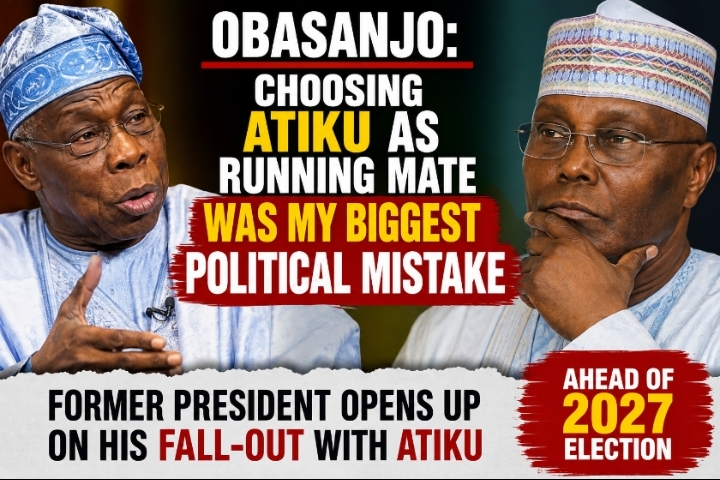
Former President Olusegun Obasanjo has described his decision to choose former Vice President Atiku Abubakar as his running mate in the 1999 presidential election as the biggest political mistake of his career, saying he would not have made the choice if he had known then what he later came to know about Atiku.
Obasanjo made the remarks on Friday in Lagos during a fireside chat with veteran entertainer Charles Oputa, popularly known as Charly Boy, at the unveiling of the Charly Boy Foundation and the launch of Oputa’s memoir, 999: A Memoir in Tribute to Late Justice Chukwudifu Oputa.
Reflecting on his years in office, the former president said his experience working with Atiku changed his perception of his former deputy.
According to Obasanjo, although he regretted selecting Atiku as his running mate, he bore no personal grudge against him.
He said he remained focused on governance despite the political disagreements that later emerged between them, adding that he was grateful the differences did not derail his administration or harm the country.
The relationship between the two leaders, who served as President and Vice President from 1999 to 2007, deteriorated during their second term in office, largely over the controversial third-term constitutional amendment widely believed to have been backed by Obasanjo.
Atiku opposed the proposal, triggering a political rift that culminated in his defection from the Peoples Democratic Party (PDP) to the then Action Congress (AC) ahead of the 2007 general election. The dispute also led to a legal battle after Obasanjo declared the office of the vice president vacant, a move later overturned by the Supreme Court.
Obasanjo has repeatedly opposed Atiku’s presidential ambitions over the years. In a 2018 interview, he said he could not support his former deputy for the presidency because of what he had come to know about him after they served together in government.
The latest comments come amid renewed political tension ahead of the 2027 presidential election.
Atiku, now the presidential candidate of the African Democratic Congress (ADC), recently accused Obasanjo of attempting to influence the election by publicly criticising him while allegedly backing another candidate.
The exchange followed Obasanjo’s renewed allegation that Atiku encouraged the late Speaker of the House of Representatives, Ghali Na’Abba, to initiate impeachment proceedings against him during his presidency—an allegation Atiku has denied.
The renewed war of words underscores the enduring rivalry between the two political heavyweights, whose once-close alliance helped usher in Nigeria’s return to democratic rule in 1999 but later evolved into one of the country’s most enduring political feuds.