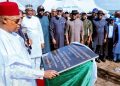





The Minister of State for Petroleum Resources (Oil), Heineken Lokpobiri, has defended the Federal Government’s decision to deregulate the downstream petroleum sector, arguing that petrol remains cheaper in Nigeria than in the United States and some other African countries.
Lokpobiri made the assertion on Tuesday during an appearance on Channels Television’s Politics Today, amid continued concerns over the cost of petrol following the removal of subsidy.
The minister’s position came as petrol prices began to ease in parts of the country following reductions in depot prices by the Dangote Petroleum Refinery and other petroleum marketers.
The Dangote refinery recently reduced its petrol depot price from ₦1,350 to ₦1,325 per litre, while other marketers also announced price cuts in Lagos, Port Harcourt, Calabar and Warri.
Despite the reductions, petrol was still being sold for between ₦1,370 and ₦1,450 per litre in some locations.
Defending the current pricing regime, Lokpobiri said available figures showed that Nigeria’s average petrol price remained below prices in the United States, Cameroon, Ghana and South Africa.
“In the US, the average, you know, litre of fuel is N1,633. In Nigeria, it’s on the average of N1,430. If you go to Cameroon, it’s N1,959. If you go to Ghana, it’s N2,070. If you go to South Africa, it’s N2,070,” he said.
The minister argued that being an oil-producing nation did not automatically guarantee cheaper petroleum products, noting that market forces and global crude oil prices also influenced the cost of refined products.
He pointed to the United States as an example, saying the country was the world’s leading oil and gas producer and had substantial refining capacity, yet its petrol price remained higher than Nigeria’s based on the figures he cited.
“Despite the fact that Dangote Refinery is here, that doesn’t mean that the fuel price will be lower because Dangote Refinery is available. But what is important is that the regulation has also created a new economy,” Lokpobiri said.
According to him, deregulation had created room for private investment in the oil and gas industry and made large-scale projects such as the Dangote refinery more viable.
The minister argued that continued government importation of petrol and sale of the product below market value would have undermined the ability of private refiners to compete.
“But for the policy of deregulation, Dangote Refinery wouldn’t have been the most attractive IPO in the continent. If government was continuously importing, as NNPC was doing, and selling at a lower price than the market price, Dangote wouldn’t have been able to survive,” he said.
Lokpobiri said the policy was designed to allow private-sector operators to participate more actively in the midstream and downstream segments of the petroleum industry.
“Deregulation all over the world is to enable private sector businesses to thrive and all the businesses that are associated with the oil and gas sector,” he said.
The minister also defended the removal of the petrol subsidy, saying the savings had increased the funds available for distribution to the Federal Government, states and local governments through the Federation Account Allocation Committee.
He said the increased allocations had enabled several states to undertake projects and meet their financial obligations.
“These days we get 2.1 trillion being shared. This is the first time it is happening. You’ll recall that before this government came, about 27 states had no capacity to pay even salaries. Today, states are doing gigantic projects. It’s because of the savings that we made from this subsidy,” Lokpobiri said.
He maintained that the pressure from higher energy prices was not peculiar to Nigeria, arguing that petroleum products were affected by developments in the international market.
“Oil and gas is a global commodity. What is sold in New York is what is also sold here,” the minister said.
Lokpobiri said the Federal Government would not reverse the deregulation policy, despite the pressure it had placed on consumers, maintaining that the policy was necessary to attract investment into the sector.
He also cited the Dangote refinery’s supply of aviation fuel and developments in Nigeria’s foreign reserves as some of the gains associated with changes in the petroleum sector.
The minister further said the Central Bank of Nigeria had indicated that about 85 per cent of the country’s foreign reserves came from the oil and gas sector.