






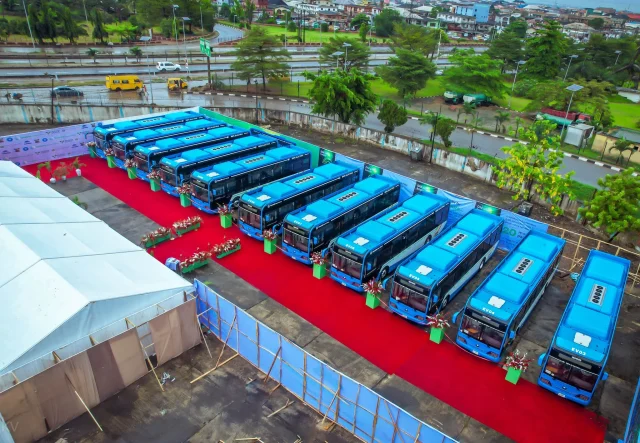
The Lagos State Government has taken another step towards transitioning to cleaner public transportation with the introduction of 11 additional electric buses under its partnership with Oando Clean Energy Limited.
The Lagos Metropolitan Area Transport Authority (LAMATA) announced the development in a statement shared on its social media platforms on Tuesday, describing the deployment as the first phase of a 50-bus commitment under the existing partnership.
The latest delivery brings the state closer to its broader plan to introduce 552 electric buses across public transport corridors, building on a pilot programme that commenced in 2023 with two electric buses.
Speaking at the presentation, the Lagos State Commissioner for Transportation, Oluwaseun Osiyemi, said adopting cleaner energy was necessary to address the transportation demands of the state’s growing population and expanding economic activities.
He explained that the government was committed to developing a transport system that prioritises environmental sustainability, technological innovation and efficient energy use.
“The future of transportation must be anchored on sustainability, energy efficiency, innovation and environmental responsibility,” Osiyemi said.
He added that the initiative formed part of Lagos State’s efforts to progressively reduce carbon emissions and achieve its net-zero target by 2050.
The Managing Director of LAMATA, Abimbola Akinajo, said the latest deployment demonstrated the progress made through cooperation between the government and private-sector investors.
She noted that electric-powered buses offered environmental benefits through reduced greenhouse gas emissions, improved air quality and lower noise levels.
“The partnership with Oando is translating a shared vision for cleaner transportation into practical results,” Akinajo said.
Also speaking, the President and Chief Executive Officer of Oando Clean Energy Limited, Ademola Ogunbanjo, described the development as a significant milestone for electric mobility in Nigeria and Africa.
According to him, the project is designed to establish a sustainable transportation framework rather than merely introduce electric-powered vehicles into the state’s transport network.
Ogunbanjo traced the partnership to April 2022, when LAMATA and Oando signed a Memorandum of Understanding, followed by the introduction of two pilot buses in 2023.
He explained that the intervening period was used to assess the technology’s performance, operational reliability, environmental benefits and acceptance among commuters before proceeding with a wider deployment.
Beyond providing the vehicles, he said the company was working towards developing supporting infrastructure, including charging stations, maintenance facilities, technical training, spare-parts supply chains and eventual local vehicle assembly.
He disclosed that the initiative had attracted financial and technical support from institutions including the Bank of Industry, Wema Bank and Yutong, while discussions were ongoing with prospective partners such as the Africa Finance Corporation and the International Finance Corporation.
Ogunbanjo expressed optimism that the Lagos experience could provide a model for other states seeking to adopt electric-powered public transportation.
“If it can work in Lagos, it can work anywhere in Nigeria. The future of mobility is electric, and that future is already taking shape here in Lagos,” he said.
The deployment is expected to provide additional operational experience for the planned expansion of electric buses while supporting the Lagos government’s broader transportation modernisation programme and environmental sustainability objectives.




