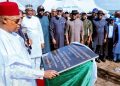






The Federal Government has commissioned six electricity transmission substations in Kano and Katsina states, adding 640 megawatts of transmission capacity to Nigeria’s national grid.
The projects are part of ongoing efforts to strengthen the country’s electricity infrastructure and improve the delivery of available power to distribution companies and consumers.
According to the Federal Ministry of Power, four of the substations are located at Walalambe, Kumbotso, Dakata and Dan-Agundi in Kano State, while the remaining two are in Kankia Local Government Area of Katsina State.
The four Kano facilities collectively provide 544MW of additional transmission capacity, while the two substations in Katsina contribute another 96MW.
The ministry announced the development in a statement on Saturday following commissioning ceremonies held during the week.
Speaking at the commissioning of the Kankia facilities on Friday, October 23, the Minister of Power, Joseph Tegbe, said the projects reflected the Federal Government’s commitment to strengthening electricity infrastructure.
“Mr. President’s Renewed Hope Agenda recognises that economic ambition requires dependable infrastructure,” Tegbe said.
He explained that investment in transmission infrastructure was important to supporting businesses, creating employment opportunities and stimulating economic growth.
The Kankia installations comprise two 60-megavolt-ampere substations operating at 132/33 kilovolts. They are designed to strengthen the transmission network serving Katsina State and neighbouring areas.
Tegbe said the facilities would improve the network’s ability to transmit available electricity and support commercial activities and household needs.
He also called on residents to protect the infrastructure against vandalism, urging them to report suspicious activities to the Transmission Company of Nigeria and relevant security agencies.
Katsina State Governor Dikko Umaru Radda described the project as a significant investment in the state’s electricity infrastructure.
He said a stronger transmission network could support industrial development, economic expansion and improved public services.
The governor commended President Tinubu, the Ministry of Power and the Transmission Company of Nigeria for completing the projects.
However, the additional 640MW represents increased transmission capacity, not new electricity generation. The extent to which consumers benefit will depend on the amount of electricity available from generating plants and the capacity of distribution networks to deliver it.
The commissioning comes amid broader efforts by the Federal Government to address bottlenecks that have limited the amount of electricity transmitted across the country.
Other interventions have included transformer installations and transmission upgrades in Lagos and Abuja, as well as along major electricity transmission corridors.
The government is also working to deploy additional power equipment to improve grid stability and strengthen the country’s electricity supply network.