





The Federal Government has deployed 13 ambulances to Ogun State as part of efforts to strengthen emergency medical services and improve access to timely and life-saving healthcare across the state.
The Minister of State for Health and Social Welfare, Dr Iziaq Salako, disclosed this on Friday during the flag-off and distribution of Advanced Trauma Life Support, Basic Life Support and tricycle ambulances to selected health facilities in Ogun State under the National Emergency Medical Services and Ambulance System.
The event was held at the Federal Medical Centre, Abeokuta.
The minister said the allocation comprised three Advanced Life Support ambulances, one Basic Life Support ambulance and nine tricycle ambulances for deployment to selected federal and state tertiary institutions, as well as high-volume, remote secondary and primary healthcare facilities.
Beneficiaries include FMC Abeokuta and Olabisi Onabanjo University Teaching Hospital.
Salako said the intervention was part of the Federal Government’s efforts under President Bola Tinubu’s Renewed Hope Agenda to strengthen emergency medical transportation, first-responder capacity, communication systems and coordination of emergency care across the country.
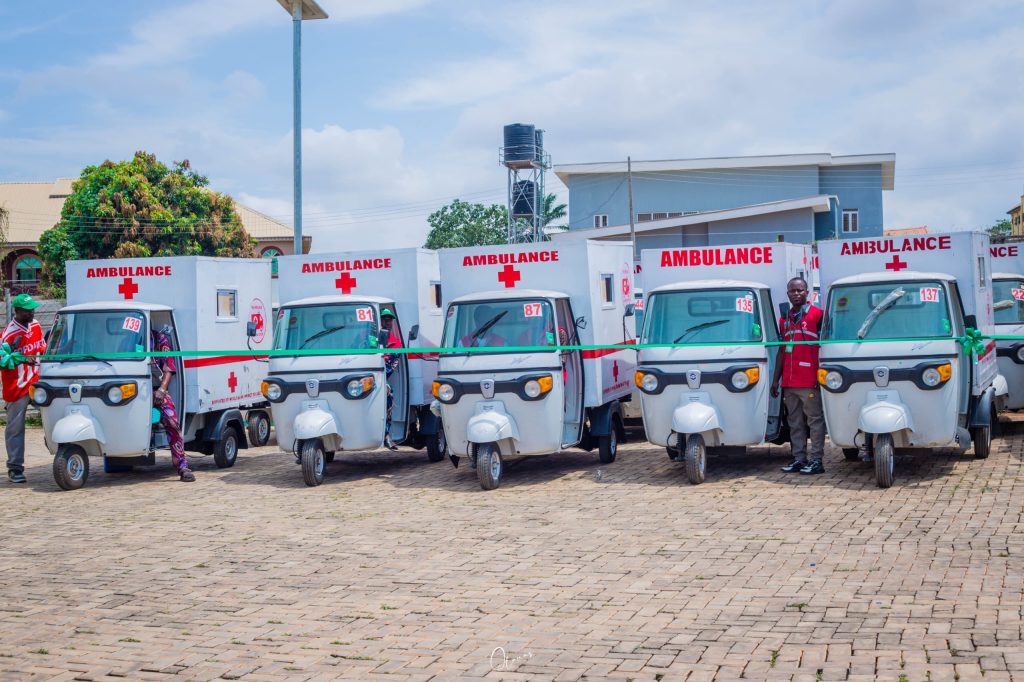
He disclosed that the Federal Government had, in the first phase of the national intervention, acquired 145 tricycle ambulances, six boats, 15 Basic Life Support ambulances and 79 Advanced Life Support ambulances, alongside communication and other support equipment.
Ambulances must not be diverted
Salako urged the Ogun State Government and beneficiary health facilities to ensure the proper deployment, maintenance and accountability of the ambulances.
He warned that the vehicles must be used strictly for emergency medical services and operated by trained personnel.
“The true value of these ambulances will be measured not by their presence at today’s ceremony, but by their performance in moments of crisis—when a mother in labour needs urgent transfer, when a road crash victim requires rapid stabilisation, or when a child in respiratory distress must reach care without delay,” he said.
The minister also warned against diverting the ambulances for non-emergency activities, stressing that beneficiary institutions must provide complementary funding for their operation and maintenance.
“These ambulances are not hearses for moving corpses or vehicles for going to the market to purchase goods, including drugs and other hospital consumables,” Salako cautioned.
He directed that the vehicles should be deployed according to identified emergency-care needs, properly maintained and subjected to effective monitoring and documentation.
FG records maternal health gains
According to the minister, the emergency medical intervention has also supported efforts to reduce maternal and newborn deaths.
He said through NEMSAS and the Maternal Mortality Reduction Innovation Initiative, more than 48,000 women had received free emergency obstetric care, while over 4,000 women had benefited from free Caesarean sections in NHIA-empanelled facilities.
Salako said the interventions had contributed to a 17 per cent reduction in maternal deaths and a 12 per cent reduction in newborn deaths across 172 high-burden Local Government Areas.
He explained that the Federal Government’s emergency healthcare strategy had moved beyond simply providing ambulances to building a coordinated system linking emergency dispatch, communication, trained personnel, pre-hospital care, transportation, referral pathways and receiving hospitals.
FG to tackle emergency response regulation
The minister also announced plans by the Federal Government to work with the National Assembly and other stakeholders to address what he described as a fragmented regulatory framework governing first responders and emergency management in Nigeria.
He said NEMSAS, in partnership with relevant Federal Government agencies, would continue efforts to establish a unified framework connecting emergency dispatch, pre-hospital care, transportation and receiving hospitals.
Salako orders probe of alleged misconduct at FMC Abeokuta
Salako also disclosed that his office had received complaints and media reports alleging unprofessional conduct, dereliction of duty and illegal collection of levies by some officials of FMC Abeokuta.
He said the allegations would be comprehensively investigated and that anyone found culpable would face appropriate sanctions in line with the Public Service Rules.
“We must sustain the confidence of the public in Federal Medical Centre, Abeokuta. When patients come to our hospitals, the minimum they expect is professional medical care, support, clear communication and respectful treatment,” he said.
The minister called for stronger collaboration among federal and state governments, health facilities, emergency responders, security agencies, private-sector stakeholders and communities to build an emergency medical system that is accessible, coordinated and sustainable.
“Every siren must symbolise hope, every response must reflect preparedness, and every rescued life must stand as evidence of a health system that is becoming stronger, more humane and more responsive to the needs of the Nigerian people,” Salako said.