






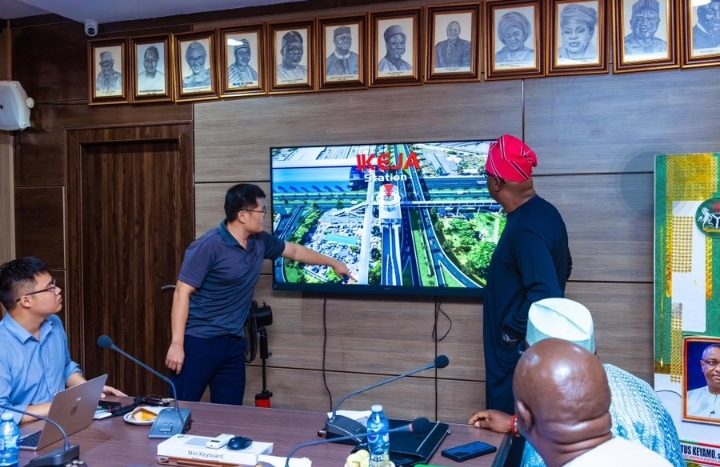
The Federal Government has approved the design for a proposed monorail linking Ikeja Railway Station, the Lagos Red Line terminus, to the Murtala Muhammed International Airport (MMIA) in Lagos, as part of efforts to improve airport accessibility and passenger movement.
The approval followed a meeting involving the Permanent Secretary of the Federal Ministry of Aviation and Aerospace Development, the Managing Director of the Federal Airports Authority of Nigeria (FAAN) and engineering teams from both institutions.
The project is expected to provide a rail connection between Ikeja and the airport’s Terminal 1, which is currently undergoing reconstruction, offering travellers an alternative to road transportation.
Announcing the development, the official involved in the project said the proposed railway would have five stations along its route.
The stations are Ikeja Station, Domestic Airport Station, Beesam Station, Toll Gate Station and MMIA Airport Station.
The official described the proposed monorail as an integral component of the ongoing modernisation of Nigeria’s major international aviation gateway, adding that the rail link was designed to improve movement between the city and the airport.
The project is expected to benefit air passengers, airport employees, visitors and businesses by providing an additional transport option for accessing the airport.
EXPECTED BENEFITS FOR TRAVELLERS, BUSINESSES
The proposed rail connection could reduce passengers’ dependence on road transportation, particularly during periods of heavy traffic on routes leading to the airport.
By connecting the airport to the Lagos Red Line, the project could also make it easier for passengers travelling from areas served by the railway to reach the airport without relying entirely on taxis, private vehicles or other road-based transport services.
The benefits could extend to airport workers and businesses operating within the airport complex, including those involved in cargo handling and logistics, by providing another means of moving people between the city and airport facilities.
The proposed stations are expected to improve access to different parts of the airport, although the actual benefits will depend on the final route, service frequency, fares, operating hours and connections with existing transport services.
The project could also support the wider development of Lagos’ public transport network by strengthening connections between the city’s railway infrastructure and one of the country’s busiest aviation facilities.
The Lagos State Government’s existing Red Line project was designed to provide an alternative to road transport, improve journey-time predictability and reduce traffic congestion. Extending the rail connection into the airport could build on those objectives by improving access to air travel.
FINANCING TALKS UNDERWAY
The proposed airport rail link forms part of the broader reconstruction and modernisation programme at MMIA.
FAAN Managing Director, Olubunmi Onabanjo-Kuku, disclosed recently that discussions on financing the project were at an advanced stage.
Speaking at the World Aviation Festival in Lisbon, Portugal, she said efforts were ongoing to finalise the funding structure for the proposed railway.
“We are actually working on completing the financing of the capital structure for that project,” she said.
Onabanjo-Kuku also explained that the proposed rail extension would connect the city to the airport and serve its terminals and cargo facilities through multiple stops.
The project involves collaboration between the Federal Government, FAAN and the Lagos State Government.
However, the completion of the design approval does not necessarily mean construction has commenced. Details of the project’s total cost, construction schedule, fares and expected opening date have yet to be established in the information available.
The railway is expected to complement the ongoing remodelling of the airport’s terminals, which is aimed at improving infrastructure, operational efficiency and the passenger experience.
When completed, the proposed connection could offer travellers a more predictable alternative for reaching the airport, while improving access for employees and businesses operating within the facility.
Its eventual impact will depend on the timely completion of the project, the quality of connections to existing transport services and the affordability and reliability of the railway for passengers.




