




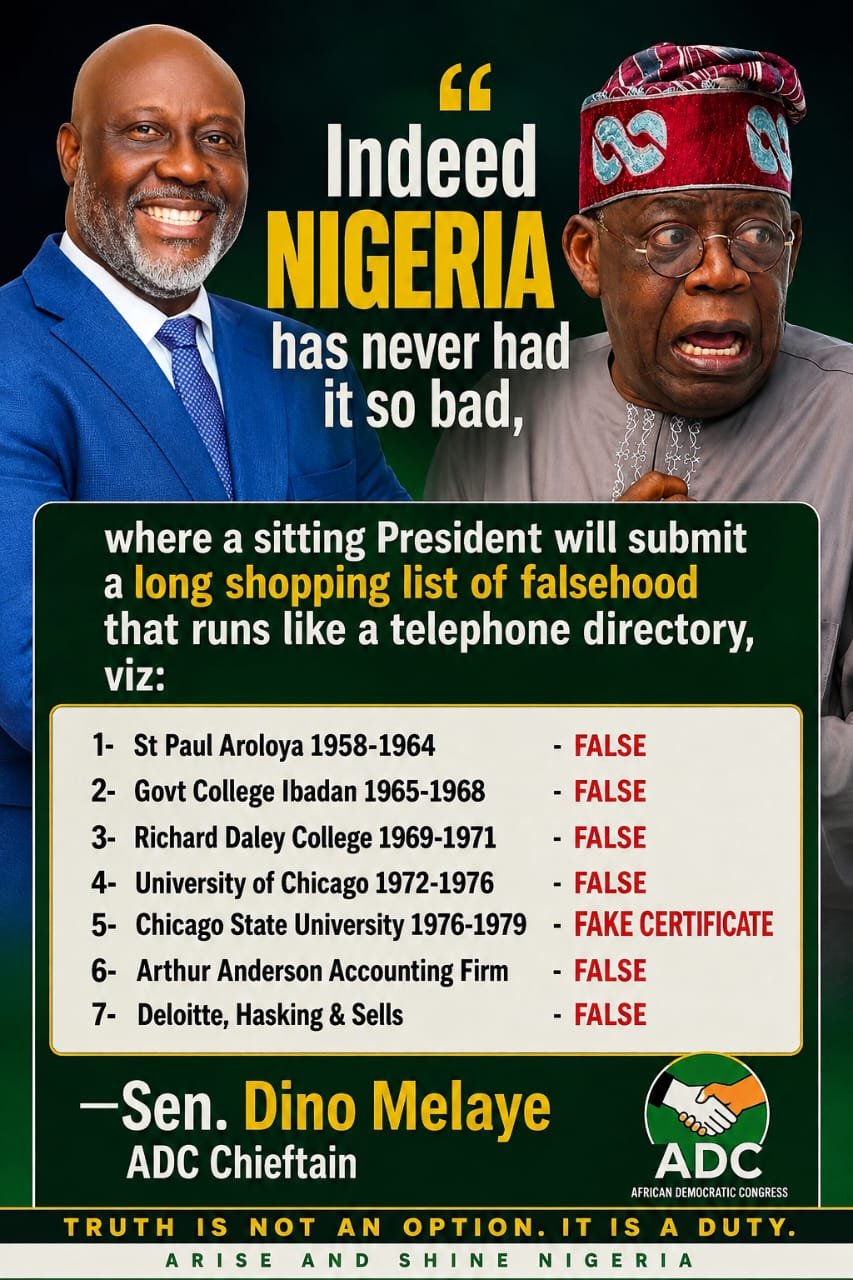
Former Kogi West Senator and chieftain of the African Democratic Congress, Dino Melaye, has reignited the controversy surrounding President Bola Tinubu’s academic and professional records, alleging that several claims about the President’s educational background and work history are false.
Melaye made the allegations in a post on his verified X (formerly Twitter) account on Wednesday night, simply captioning the post, “Truth.”
The post featured a campaign-style graphic accusing Tinubu of submitting what it described as “a long shopping list of falsehood” regarding his academic qualifications and employment history.
According to the graphic, the ADC chieftain alleged that Tinubu’s claimed attendance at St. Paul Aroloya between 1958 and 1964, Government College Ibadan from 1965 to 1968, Richard Daley College between 1969 and 1971, the University of Chicago from 1972 to 1976, Arthur Andersen Accounting Firm and Deloitte, Haskins & Sells were all false.
The graphic also renewed allegations surrounding Tinubu’s certificate from Chicago State University, describing it as a “fake certificate.”
The fresh claims come amid renewed political exchanges over the President’s educational and personal records ahead of the 2027 general elections, with opposition figures intensifying criticism of the Tinubu administration.
Neither the Presidency nor President Tinubu had responded to Melaye’s latest allegations as of the time of filing this report.
Tinubu has consistently defended the authenticity of his academic credentials. The certificate controversy gained international attention during the 2023 presidential election litigation, during which documents relating to his attendance at Chicago State University were subjected to legal scrutiny in the United States and Nigeria. The President has repeatedly maintained that he attended the institution and that his qualifications are genuine.
Melaye’s latest remarks are expected to further fuel political debate as opposition parties continue to challenge the administration on issues of governance and accountability.