






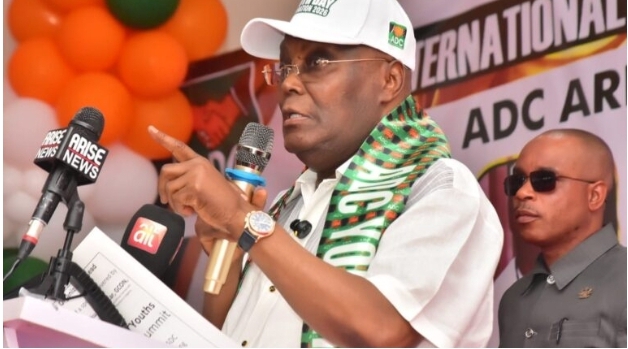
Former Vice-President and African Democratic Congress presidential candidate, Atiku Abubakar, has proposed a $10 billion financing programme for young entrepreneurs and start-ups as part of measures he says would strengthen local production and reduce Nigeria’s dependence on raw-material exports.
Atiku also called for greater investment in agro-processing, manufacturing, mineral beneficiation and industrial clusters, arguing that Nigeria should process its raw materials locally before exporting them.
He made the proposals in a statement issued on Tuesday by his Senior Special Assistant on Public Communication, Phrank Shaibu, while criticising the economic policies of President Bola Tinubu’s administration.
Atiku said Nigeria’s raw-material exports increased by 106 per cent, from N1.86 trillion in the first half of 2025 to N3.84 trillion in the corresponding period of 2026.
According to him, the increase would have greater economic benefits if more of the commodities were processed locally before export.
“There is nothing wrong with exporting. The problem is exporting the cheapest part of the value chain and buying back the expensive part,” he said.
The former vice-president cited cocoa, hides, cotton and minerals as examples of commodities that could generate greater economic value if processed into chocolate, leather products, textiles and finished mineral products.
“When we export cocoa beans instead of cocoa butter, powder and chocolate, hides instead of leather products, cotton instead of garments and minerals without processing them, we are handing other countries the opportunity to make the real money from resources that came from Nigerian soil,” he said.
Atiku said his proposed economic recovery plan would provide affordable long-term financing for businesses while encouraging industrial clusters, agro-processing and companies involved in adding value to locally sourced raw materials.
He said the proposed $10 billion financing programme would target young entrepreneurs and start-ups operating in agriculture, manufacturing, processing, packaging, logistics, technology and distribution.
Atiku also linked the need for increased domestic production to the reported rise in unsold manufactured goods, which he put at about N2.14 trillion.
He attributed the development to weak consumer demand and rising production costs, saying manufacturers were facing higher expenses for fuel, electricity, credit and transportation, while households had less disposable income.
“Manufacturers pay more to produce, and families have less money to buy. That is why factory shelves are full while kitchen cupboards are empty,” Atiku said.
The ADC candidate further proposed a production-linked fuel subsidy under which support would be tied to petroleum products refined in Nigeria, verified domestic supply and measurable benefits to consumers.
“No production, no subsidy. No domestic supply, no subsidy. No measurable benefit to Nigerians, no subsidy,” he said.
Atiku said expanding local manufacturing and processing would enable Nigeria to export more finished products, earn additional foreign exchange and reduce pressure on the naira.
“When we process more of what we produce, manufacture more of what we consume and export more finished goods, we earn more foreign exchange and strengthen the economy,” he said.
He added that his economic plan would seek to make production cheaper, improve the operating environment for businesses and increase the value derived from Nigeria’s natural and agricultural resources.
“You cannot rebase your way to prosperity. A $1 trillion economy must be something Nigerians can feel in their salaries, their markets, their businesses and their homes,” Atiku said.




