





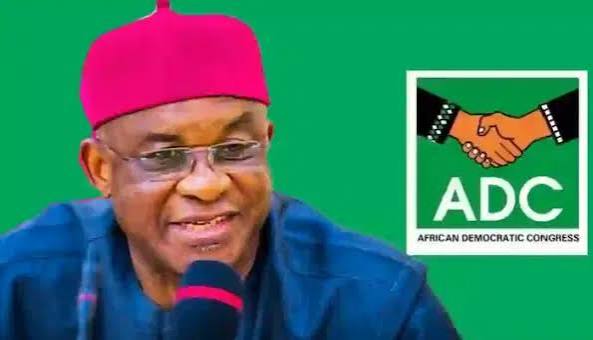
The African Democratic Congress (ADC) has rejected a Federal High Court judgment in Abuja nullifying the leadership of former Senate President David Mark and invalidating decisions taken under his leadership, including the process that produced former Vice-President Atiku Abubakar as the party’s presidential candidate for the 2027 general elections.
The party described the judgment as unacceptable and vowed to challenge it through all available judicial processes.
The judgment, delivered on Thursday by Justice Peter Lifu, followed a protracted leadership dispute instituted by Nafiu Bala Gombe, a former ADC Deputy National Chairman (North-East), who challenged the emergence of Mark and other members of the caretaker committee.
The court held that the Mark-led caretaker committee was constituted in violation of the party’s constitution, the Electoral Act and the 1999 Constitution. It also invalidated decisions taken by the committee and directed the Independent National Electoral Commission not to recognise or act on decisions arising from the party’s 99th National Executive Committee meeting held on July 27, 2025.
Reacting in a statement issued on Thursday, the ADC National Publicity Secretary, Bolaji Abdullahi, said the party would await the Certified True Copy of the judgment before determining its precise scope and next legal steps.
The statement, titled, “Lifu Judgment: APC Wants to Set Nigeria on Fire,” questioned the timing of the ruling, alleging that it came amid growing public support for the opposition party and its political activities.
“Yesterday, Nigerians came out in their hundreds of thousands to demonstrate their support for the ADC and our promise of making life affordable for them. Today, they are being told that the party that they support and the candidates that they have supported at all levels could be erased by the stroke of a reckless judicial pen.”
The party argued that the dispute went beyond the political interests of Mark or Atiku, insisting that the judgment could affect the democratic rights of thousands of candidates seeking to contest the 2027 elections.
“Do these people understand what they are playing with? This is not about Atiku Abubakar or David Mark. It is about the democratic rights of Nigerians to freely choose their own leaders. It is about the rights of thousands of candidates to participate in a democratic process.”
The ADC also questioned the legal basis of the ruling, citing an earlier judgment delivered by Justice Musa Liman on July 2, 2026, in suit FHC/ABJ/CS/1637/2025, which it said affirmed the legitimacy of the Mark-led National Working Committee and directed INEC to recognise the leadership.
The party maintained that a court of coordinate jurisdiction could not overturn or invalidate a subsisting judgment delivered by another court of equal status.
“It is a settled principle of Nigerian jurisprudence that a court of coordinate jurisdiction cannot sit on appeal over, review, vary or nullify the subsisting judgment of another court of equal jurisdiction.”
It further alleged that the latest ruling was part of a pattern of attempts to weaken opposition parties through court decisions.
“We have seen this script before. When they are scared that the opposition is gathering steam, they use their judges in the courts to influence legally indefensible judgments.”
The party, however, said it would obtain the Certified True Copy of the judgment to establish its precise terms, scope and consequential orders before proceeding with its legal challenge.
“The ADC, therefore, rejects any consequential orders founded on a determination that appears to disregard these fundamental legal principles. However, we await the Certified True Copy (CTC) of the said judgment to ascertain its precise terms, scope and operative orders.”
The dispute dates back to July 2025, when opposition figures, including Atiku, Peter Obi, Rotimi Amaechi, Nasir El-Rufai and Rauf Aregbesola, adopted the ADC as a platform for a coalition ahead of the 2027 general elections.
The coalition was formally unveiled at the Shehu Musa Yar’Adua Centre in Abuja on July 2, 2025, with Mark emerging as interim National Chairman and Aregbesola as interim National Secretary.
However, Bala Gombe opposed the arrangement, claiming that he was entitled to assume the party’s leadership in line with its constitution. He subsequently instituted a suit challenging the leadership structure.
The dispute generated a series of legal proceedings, including decisions by the Court of Appeal and the Supreme Court, while INEC’s recognition of the Mark-led leadership also became a subject of contention.
Following Thursday’s judgment, counsel to the plaintiff, Lukman Fagbemi (SAN), said the ruling nullified actions taken by the Mark-led leadership since July 2025.
Another counsel, Luka Musa Haruna (SAN), said the decision had effectively left the party without candidates for the 2027 presidential, governorship, National Assembly and State Assembly elections.
The ADC, meanwhile, warned against actions capable of undermining the country’s democratic stability, urging its members to remain calm and law-abiding.
“The peace and stability of Nigeria are bigger than the ambition of any president or political party. Nobody should be so desperate to retain power that they are prepared to put the entire country at risk.
“Nigeria belongs to Nigerians, not to the APC. The presidency is not an inheritance. If the President thinks he has performed well in office, why is he afraid of competition?”
HOW THE ADC LEADERSHIP CRISIS STARTED
The latest development is the culmination of a prolonged leadership dispute that began following the opposition coalition’s decision to adopt the ADC as its political platform ahead of the 2027 general elections.
After the 2023 general elections, opposition figures, including Atiku, Mark, former Labour Party presidential candidate Peter Obi, former Rivers State Governor Rotimi Amaechi, former Kaduna State Governor Nasir El-Rufai and former Osun State Governor Rauf Aregbesola, began exploring ways to build a coalition against the ruling APC.
Rather than establish a new political party, the coalition settled for the ADC, which was formally unveiled on July 2, 2025, at the Shehu Musa Yar’Adua Centre in Abuja.
At the event, the party’s former National Chairman, Ralph Nwosu, announced that the existing national leadership had agreed to step aside to accommodate the coalition.
Mark subsequently emerged as interim National Chairman, while Aregbesola became interim National Secretary.
However, the arrangement immediately generated opposition from Nafiu Bala Gombe, a former ADC National Deputy Chairman (North-East), who argued that he was constitutionally entitled to assume the party’s leadership following Nwosu’s resignation.
Bala rejected the process through which Mark emerged, insisting that the transition violated the party’s constitution.
COURT BATTLE AND INEC’S POSITION
On September 2, 2025, Bala instituted a suit at the Federal High Court in Abuja, challenging the legitimacy of the Mark-led leadership.
The suit, marked FHC/ABJ/CS/1819/2025, listed the ADC, INEC, Mark, Aregbesola and Nwosu as defendants.
Among other reliefs, Bala asked the court to restrain Mark and Aregbesola from parading themselves as the party’s National Chairman and National Secretary.
Despite the pending litigation, INEC initially recognised the Mark-led leadership, publishing the names of Mark and other national officers on its website on September 10, 2025.
However, the commission subsequently withdrew its recognition of the competing leadership structures following a Court of Appeal intervention in March 2026.
The appellate court had directed the parties to maintain the status quo ante bellum pending the determination of the substantive dispute.
On April 30, 2026, the Supreme Court set aside the Court of Appeal’s status quo order and directed the parties to return to the Federal High Court for an expedited hearing of the substantive case.
INEC subsequently restored the names of Mark and other members of his leadership to its database.
The Supreme Court, however, did not finally determine the substantive question of who was entitled to lead the ADC.
The dispute also extended to the party’s state structures, with another Court of Appeal decision in July 2026 placing restrictions on INEC’s recognition of state congresses organised by committees appointed by the Mark-led leadership.
FEDERAL HIGH COURT NULLIFIES MARK’S LEADERSHIP
The prolonged dispute reached a critical point on Thursday, November 5, 2026, when Justice Peter Lifu of the Federal High Court in Abuja delivered judgment in favour of Bala.
The court declared the Mark-led caretaker committee illegal, holding that its emergence violated the ADC constitution, relevant provisions of the Electoral Act and the 1999 Constitution.
Justice Lifu also invalidated decisions taken under the disputed leadership, including the emergence of Aregbesola as National Secretary and the party’s nominations for the 2027 general elections.
The court further ordered INEC not to recognise or act on decisions taken at the ADC’s 99th National Executive Committee meeting held on July 27, 2025.
Speaking after the judgment, counsel for the plaintiff, Lukman Fagbemi (SAN), said the ruling nullified actions taken by the party under the Mark-led leadership.
“All the actions taken by the ADC as a party since July 27 to date stand annulled,” he said.
Another counsel to the plaintiff, Luka Musa Haruna (SAN), said the decision effectively left the party without candidates for the 2027 presidential, governorship, National Assembly and state assembly elections.
The judgment followed Bala’s argument that he was constitutionally entitled to assume the party’s leadership after the resignation of the former national executives.
IMPLICATIONS FOR ATIKU’S 2027 PRESIDENTIAL AMBITION
The ruling has also thrown the presidential ambition of Atiku into uncertainty, as the former Vice-President emerged as the ADC’s presidential candidate through a primary organised under the Mark-led leadership.
Atiku’s name had earlier been published by INEC as the party’s presidential candidate for the 2027 elections.
He had also picked former Rivers State Governor, Rotimi Amaechi, as his running mate ahead of the presidential contest.
However, the court’s decision to invalidate the actions of the Mark-led leadership, including the process that produced Atiku, has placed the validity of the presidential ticket in doubt.
The ruling also affects the party’s other nominations for the 2027 elections, potentially forcing it to reconsider its electoral arrangements depending on the outcome of further legal proceedings.
The ADC’s proposed appeal does not automatically suspend or reverse the judgment.
WHAT NEXT FOR THE ADC?
The immediate challenge before the opposition party is how to resolve its leadership crisis while pursuing its planned appeal against the judgment.
The party is also expected to obtain the Certified True Copy of the ruling to determine the precise orders made by the court and formulate its legal response.
The outcome of the appeal, INEC’s response and the emergence of a legally recognised leadership structure will be crucial to the party’s preparations for the 2027 general elections.
Although the judgment does not dissolve the ADC as a registered political party, it creates uncertainty over who has the legitimate authority to control its affairs, make binding decisions and present candidates for elective positions.
The crisis also raises broader questions about the future of the opposition coalition, which had adopted the ADC as a platform to challenge the APC in the forthcoming elections.
What began as an effort to unite opposition figures has now developed into a major legal and political contest over party ownership, constitutional authority and the validity of decisions taken under its disputed leadership.
For Mark and his associates, the judgment represents a significant setback to the coalition arrangement they helped establish.
For Bala, it is a major legal victory in his challenge to the leadership transition.
For Atiku, it introduces fresh uncertainty into his 2027 presidential ambition, while the opposition coalition faces the task of resolving its internal crisis before the next general elections.
The ADC’s next legal move and the response of INEC are expected to shape the party’s political future and determine the extent to which it can proceed with its 2027 electoral preparations.