




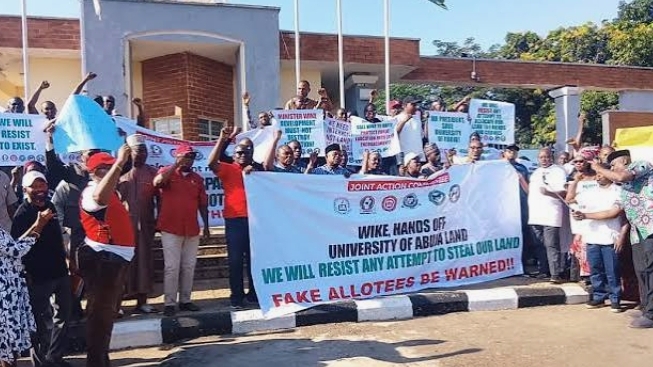
The Federal Capital Territory Administration (FCTA) has described Monday’s protest by the Joint Action Committee (JAC) of the University of Abuja over the reduction of the institution’s land from 11,824.04 hectares to 4,685 hectares as misplaced, insisting that FCT Minister, Nyesom Wike, only implemented an approval granted by his predecessor, Mohammed Musa Bello.
The FCT Minister’s Senior Special Assistant on Public Communications and Social Media, Lere Olayinka, stated this in a statement on Monday, challenging the protesters to explain why the university would require more than 11,000 hectares of land after 38 years of its establishment.
Olayinka maintained that Wike’s action was based on the recommendations of a joint committee set up by the FCTA and the university in 2016 to address land-related issues.
He disclosed that the committee, inaugurated on November 10, 2016, was mandated to examine the university’s land size, encroachment by indigenous settlers, illegal developments around its Gwagwalada Mini Campus and the issuance of land titles for its two campuses.
According to him, five of the committee’s 12 members were representatives of the university, including Prof. Otaki Alanana, Prof. A. Mallam, Mohamed Kassim, A.E. Ripite and Sadiq O. Shuaibu.
He said the committee recommended that the university’s main campus land, which covered more than 11,000 hectares, was excessive and should be reduced to the 100 hectares recommended by the National Universities Commission (NUC).
“The committee recommended, amongst others, that the land area of over 11,000 hectares of the main campus was far beyond the recommended size by the National Universities Commission (NUC), and that the recommended size of 100 hectares by the NUC be given to the university,” he said.
Olayinka said the report was approved by Bello, adding that Wike subsequently approved 4,519.80 hectares for the university, bringing its total allocation to 4,685 hectares.
He also alleged that the university had been allocating portions of the disputed land to individuals and corporate organisations, including the Economic and Financial Crimes Commission (EFCC), to which it reportedly allocated 100 hectares without recourse to the FCTA.
Questioning the rationale behind the protest, the FCTA spokesman challenged the university’s staff unions, students and alumni to justify the institution’s demand for such an extensive land area.
“Where in the civilised world is a university built on over 11,000 hectares of land, on which over 220,000 houses can be built at 500 square metres per plot?” he asked.
He further questioned how the land reduction would affect the university’s academic activities, staff welfare and students’ education.
“If the government that owns a university chooses to reduce the size of its land on which no structure has been built in the school’s 38 years of existence, what effect will that have on ASUU, SSANU and NASU? Will that affect the payment of their salaries? Will it affect the students in terms of their studies?” he queried.
Olayinka urged the Academic Staff Union of Universities (ASUU), Senior Staff Association of Nigerian Universities (SSANU), Non-Academic Staff Union of Educational and Associated Institutions (NASU), Students’ Union Government and the university’s alumni association to explain their interests in the land dispute.
“ASUU, SSANU and NASU should be honest enough to tell Nigerians what their real interests are in a land matter between a university and the government from which it got the land allocation in the first place,” he said.