




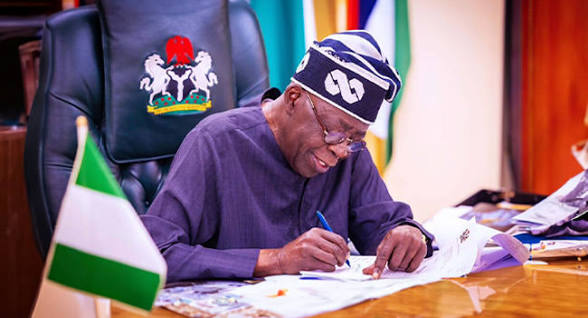
President Bola Tinubu has directed the Federal Government to commission a comprehensive forensic investigation into the scandal involving the fictitious Presidential Foreign Intervention Promotion Council and other suspected fake agencies within the Federal Government.
The Minister of Finance and Coordinating Minister of the Economy, Taiwo Oyedele, disclosed this on Wednesday while briefing State House correspondents after the Federal Executive Council meeting at the Presidential Villa, Abuja.
Oyedele said the investigation would examine government processes, procedures and internal controls that may have allowed the creation and registration of fictitious government agencies.
He said the investigation became necessary following findings by the Independent Corrupt Practices and Other Related Offences Commission that the scandal extended beyond the initially identified fake council.
“The council has directed that we commission a forensic investigation that will look into our processes, our procedures, internal control weaknesses that allow some of these things to happen, because the findings discovered that we indeed have additional fake agencies,” Oyedele said.
According to him, the objective is to establish what went wrong, identify those responsible and strengthen government systems to prevent similar incidents in the future.
The minister said the Attorney-General of the Federation and his ministry had been directed to work with other relevant agencies to examine the matter from administrative, accounting and governance perspectives.
Oyedele also disclosed that President Tinubu ordered the investigation to cover the Integrated Personnel and Payroll Information System, warning that the existence of fake agencies could indicate the presence of fictitious employees on the Federal Government payroll.
“Mr President directed that the review should extend to IPPIS, because if you have fake agencies, you most likely have fake employees,” he said.
The minister said the government could not afford fictitious personnel on its payroll at a time when the administration was working to improve the payment of salaries and wages of genuine public servants.
Oyedele disclosed that about N9.495tn in subsidy savings and incremental revenue had been used to fund incremental salary and allowance payments to civil servants, saying the figure exceeded the actual savings that accrued to the Federal Government from the removal of fuel subsidy.
He said the government would not allow fake agencies or personnel to undermine efforts to improve workers’ welfare and strengthen public finances.
“Something went wrong. Someone managed, with whatever people they colluded with, to create a fake agency that had an office within the institution of the Federal Government,” Oyedele said.
He added that the fictitious agency had allegedly obtained an administrative code and a Treasury Single Account code, although no funds were ultimately paid into the accounts.
“The only thing that didn’t happen was we didn’t pay any money to those accounts. But it’s gone too far to even get to that level. Now the idea is we want to find out what went wrong and strengthen the system,” he added.
The Minister of Information and National Orientation, Mohammed Idris, said the ICPC findings revealed that at least two additional fake agencies were involved in the wider administrative loopholes uncovered during the investigation.
Idris said the President had therefore ordered a broader review of the government’s administrative and accounting systems, including the engagement of professional audit firms to conduct a forensic assessment.
“So that we have a forensic, total evaluation of this system, with a view to plugging this once and for all, so we don’t have this national embarrassment again,” Idris said.
The minister cautioned against attributing the entire development to the present administration, saying some of the irregularities might have existed before Tinubu assumed office.
“I want you to know that this didn’t just happen now. It is possible that this dates back longer than when the President was in office,” Idris said.
He added that Tinubu was also interested in determining whether similar incidents had occurred in other parts of the Federal Government and ensuring that the loopholes were permanently blocked.
Meanwhile, the Federal Executive Council approved the signing of Double Taxation Avoidance Treaties between Nigeria and Ghana, Tanzania and Switzerland.
Oyedele said the agreements were designed to expand opportunities for Nigerian businesses to invest abroad while attracting more foreign investment into the country.
“We’re hoping that Nigeria can develop a very robust tax treaty network to compete with leading countries in Africa, like South Africa, which has over 60. But we’re making good progress,” he said.
The council also approved a $1.25bn financing facility from the International Development Association and the International Bank for Reconstruction and Development to support Nigeria’s Actions for Investment and Job Acceleration development policy financing.
Oyedele said the concessional facility, which has a repayment period of about 30 years, would be directed towards accelerating investment and job creation.
“If we have any priority as a country, this clearly has to be one of them,” the minister said.