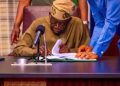




The proposed State Police system will not give governors absolute control over police operations in their states, Chairman of the Presidential Working Group on the National Policing Bill, Femi Gbajabiamila, has said.
Gbajabiamila said the proposed policing framework was being designed with safeguards to prevent political interference and ensure that state police services remained professional, accountable and subject to the law.
He spoke while explaining the structure of the proposed Federal and State Police Services, amid concerns that governors could use state police to intimidate political opponents or suppress lawful opposition.
According to him, decentralising the police force would not mean handing over unrestricted policing powers to state governors.
“No political office holder should be able to direct the arrest of an opponent, the suppression of lawful political activity, or the selective enforcement of the law,” Gbajabiamila said.
He stressed that the proposed reform was intended to bring policing closer to the people without compromising national standards, human rights and the rule of law.
The Chief of Staff to President Bola Tinubu also warned that state police must not become instruments of political control, saying “State police cannot mean 36 state militias.”
Under the proposed framework, state police commissioners would not simply become political appointees of governors. The system is expected to provide institutional checks around appointments, recruitment, discipline, funding and operational oversight.
Gbajabiamila said the proposed legislation would also establish minimum national standards that every state police service must meet before becoming operational.
The standards would cover areas including recruitment, training, equipment, firearms control, financial sustainability, complaints handling, pensions and independent oversight.
He explained that a state would only be allowed to commence policing operations after demonstrating its capacity to meet the prescribed requirements.
“Operational commencement must be based on readiness, not announcement,” he said, adding that no Nigerian should receive a lower standard of police protection because of the state in which they live.
The proposed arrangement will also retain a role for the Nigeria Police Force in states that are unable to immediately establish operationally ready state police services.
Gbajabiamila said the federal police would continue to provide policing in such states until they were able to meet the required standards.
“The federal police remains in place until such a time when the state is able to come on board with the state police,” he said.
The working group chairman said the reform would require more than a constitutional amendment, noting that several operational and legal issues must be addressed before state police can function.
These include command structures, jurisdiction, funding, intelligence sharing, firearms regulation, inter-state cooperation, complaints mechanisms, human rights safeguards and the transition from the existing policing arrangement.
He disclosed that the working group was preparing an executive bill package for presentation to President Tinubu on September 3, 2026.
The package, he said, would provide the legal and operational framework required to implement the proposed dual policing structure once the constitutional amendment establishing state police comes into force.
Gbajabiamila, however, clarified that state police does not yet exist anywhere in the country, as the constitutional amendment required to establish it has not been fully completed.
“The constitutional amendment is not yet in force. Until that process is concluded and the necessary implementing laws are enacted, there is no operational state police service anywhere in Nigeria, and the Nigeria Police Force remains the constitutionally recognised police institution,” he said.
The proposed reform is also expected to establish mechanisms for coordination between the Federal Police Service and State Police Services, particularly in areas involving interstate crime and national security.
The Nigeria Governors’ Forum has backed the initiative, with Ogun State Governor Dapo Abiodun saying the legislation would clarify the respective powers of federal and state police authorities.
Abiodun said the proposed bill would determine where the powers of the Federal Police end and where those of State Police begin.
“Where do the powers of the Federal Police stop? Where do the powers of the State Police start?” he asked.
He also acknowledged concerns over the financial capacity of some states to establish and maintain police services, saying the proposed framework could include federal grants to support states at the initial stage.
Attorney-General of the Federation and Minister of Justice, Lateef Fagbemi, similarly said the reform must not allow state policing to become a tool for political persecution.
Fagbemi said federal policing would remain available in states that were not yet capable of operating their own police services.
“The main thrust of this bill is to ensure security of lives and property, and it is also important that we do not make state policing a weapon of political persecution or oppression,” the AGF said.
He added that minimum policing standards were necessary to ensure that Nigerians received comparable levels of protection regardless of their location.
The proposed state police system is therefore being structured around a dual objective: bringing policing closer to communities while preventing the concentration of police powers in the hands of individual governors.
The working group is expected to complete the legislative framework and subject it to further consultation before the proposed bill is transmitted to the National Assembly for consideration.