



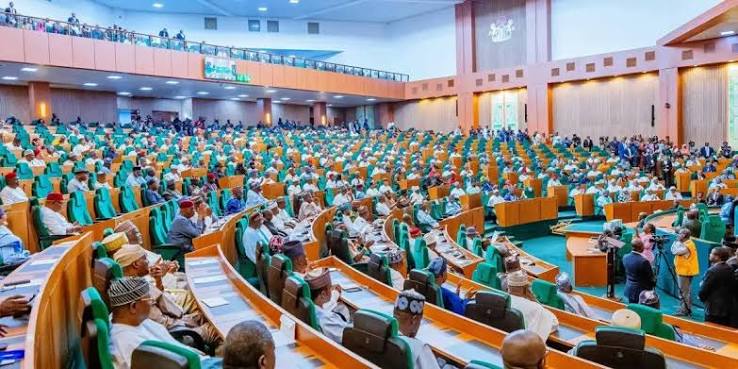
Proceedings in the House of Representatives on Wednesday were disrupted by a heated row over a proposal to invite President Bola Tinubu to appear before lawmakers over delays in the implementation of the 2025 Appropriation Act and the suspension of payments for constituency projects.
The disagreement, which lasted for about 30 minutes, forced Speaker Tajudeen Abbas to repeatedly call lawmakers to order before eventually ruling against the controversial prayer, saying it was not contained in the original motion submitted to the House.
The controversy began when Benedict Etanabene, who represents Okpe/Sapele/Uvwie Federal Constituency of Delta State, raised a point of privilege over a June 29 circular issued by the Accountant-General of the Federation, Shamseldeen Ogunjimi.
The circular directed all Ministries, Departments and Agencies (MDAs) to suspend payments for constituency and Zonal Intervention Projects (ZIPs) until such projects receive clearance from the Ministry of Special Duties and Intergovernmental Affairs.
Etanabene argued that the directive could further stall implementation of the 2025 budget and urged the House to invite President Tinubu to explain the development.
The issue resurfaced when Alex Mascot Ikwechegh, representing Aba North/Aba South Federal Constituency of Abia State, moved a motion of urgent public importance on what he described as the poor implementation of the 2025 budget.
Ikwechegh lamented that several ministers and heads of agencies, while defending their 2026 budget proposals before House committees, disclosed that little or no capital funds had been released to their institutions during the current fiscal year despite appropriations approved by the National Assembly.
He warned that the funding gap had slowed government projects and undermined service delivery across the country.
As part of the motion, the lawmaker proposed that President Tinubu be invited to brief the House on the delays in budget implementation and the withholding of funds for constituency projects.
Another member reportedly sought an amendment calling for the suspension of plenary for one week until the matter was addressed, further escalating tensions on the floor.
The proposal sharply divided lawmakers.While some members backed the invitation, insisting that the President, as head of the Executive, should account for the slow pace of budget implementation, others argued that officials directly responsible for executing the budget should be held accountable instead.
Among those who opposed the move was Yusuf Gagdi, representing Pankshin/Kanke/Kanam Federal Constituency of Plateau State, who maintained that implementation of the budget rests with the relevant ministries and agencies rather than the President personally.
His remarks were met with loud shouts of “sit down” from some lawmakers, further throwing the chamber into disorder.
Intervening, Speaker Abbas ruled that the motion as presented on the floor differed from the version earlier submitted through legislative procedure.
Describing the alteration as “completely unparliamentary,” the Speaker declined the prayer seeking to invite the President, stressing that the House could not deliberate on provisions that were not part of the approved motion.
He subsequently referred the matter to an ad hoc committee to be constituted for further legislative consideration.
The incident comes amid growing concerns in the National Assembly over delays in the release of funds for capital projects and constituency interventions captured in the 2025 budget.
Lawmakers have repeatedly complained that inadequate releases to MDAs have slowed project execution and affected service delivery nationwide.
The Accountant-General’s office has also come under increased scrutiny in recent days.
On Tuesday, the House Public Accounts Committee issued a final summons to Accountant-General Shamseldeen Ogunjimi over his repeated failure to honour invitations and submit documents requested by the committee, warning that sanctions could follow if he fails to appear.
Despite the heated exchanges, the House did not adopt any resolution compelling President Tinubu to appear before lawmakers, leaving the matter for further legislative consideration.