






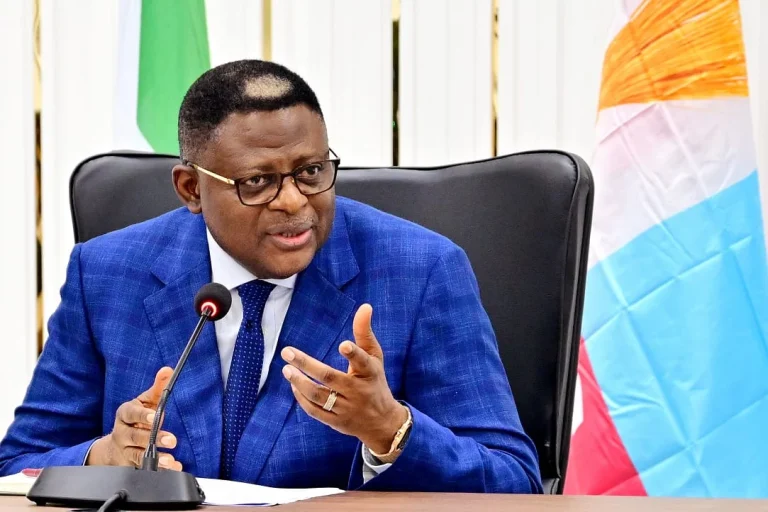
Cross River State Governor, Bassey Otu, says his administration has reduced the state’s domestic debt by more than ₦70bn since assuming office in May 2023.
Otu disclosed this on Saturday in Calabar while inaugurating the All Progressives Congress (APC) Campaign Council for the 2027 general elections.
He said his administration inherited a domestic debt burden of over ₦204bn, alongside insecurity and a demoralised workforce, but had succeeded in reducing the debt to a lower level without obtaining fresh loans.
“The state’s domestic debt profile stood at over ₦204bn as of May 2023 when I assumed office, but this figure has now been reduced as of March 2026, without contracting fresh loans. We inherited huge debts, but we have reduced them by ₦70bn,” the governor said.
He also disclosed that the state’s internally generated revenue increased from ₦21.1bn in 2022 to ₦46.3bn in 2024, attributing the improvement to stronger fiscal discipline and enhanced revenue generation.
According to him, his administration’s initial priority was to stabilise the state’s finances, recover abandoned assets and create the foundation for economic growth.
“We did not promise all things in one year, but we covenanted to stop the bleeding, clear the ground, recover the losses and restore abandonments. Every debt retired is freedom for our children and house-cleaning for fresh fiscal air,” Otu said.
The governor listed the recovery of Tinapa from the Asset Management Corporation of Nigeria (AMCON), the retrieval of nearly ₦1bn from Etung Cocoa Estates and efforts to reclaim the state’s oil wells as some of the achievements recorded by his administration.
He also cited ongoing efforts to protect Cross River’s interests in Bakassi and the proposed Deep Seaport.
On workers’ welfare, Otu said his government had lifted the employment embargo, restored more than 3,000 local government workers to the payroll and commenced the payment of gratuities after nearly two decades.
In the infrastructure sector, he highlighted the reconstruction of the Obudu Cargo Airport runway, the revival of the Teachers Continuous Training Institute in Biase and the conversion of the College of Education, Akamkpa, into the University of Entrepreneurship.
He added that his administration was promoting agricultural production, particularly in cocoa, rice, potatoes, oil palm and cassava, to strengthen food security and create employment opportunities in rural communities.
Otu further disclosed that more than 200 kilometres of fibre infrastructure had been deployed in Calabar, while over 600 residents had received information and communication technology training.
He described the state’s selection by the World Bank GovTech Team for the 2026 Artificial Intelligence in Governance and Public Administration Bootcamp in Seoul, South Korea, as recognition of its efforts to improve digital governance.
Outlining his administration’s second-term priorities, the governor said the focus would be on converting recovered assets into productive ventures, completing major infrastructure projects, expanding youth and agricultural enterprise programmes and establishing industrial parks across the three senatorial districts.
He also promised further improvements in workers’ welfare.
Addressing members of the newly inaugurated campaign council, Otu charged them to take the administration’s achievements to the 18 local government areas and 196 wards of the state.
He urged the council to base its campaign for the 2027 elections on verifiable achievements and the state’s development agenda.
“Continuity is an attitude of maturity. You do not change a farmer who has cleared the farm just when it is time to plant. You do not abandon a builder who has laid the foundation when it is time to raise the roof,” he said.
The governor subsequently inaugurated the campaign council and called on its members to conduct issue-based campaigns centred on the development of Cross River State.




