




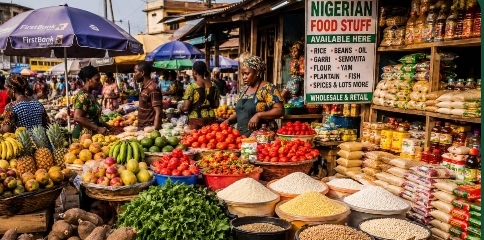
A new report by Rome Business School Nigeria says weak infrastructure, poor storage systems and rising economic pressure are reshaping how Nigerians eat, spend and survive.
Nigeria’s food sector, valued at over $233 billion, is facing mounting pressure from infrastructure gaps, rising costs and changing consumer behaviour, according to a newly released research report by Rome Business School Nigeria.
The report, titled “The Food Sector in Nigeria: Consumption Patterns, New Business Models, and Emerging Opportunities,” highlights growing concerns over food losses, affordability challenges and inefficiencies across the country’s supply chain despite significant investment opportunities within the sector.
According to the findings, Nigeria loses nearly 50 percent of its perishable food production annually, amounting to approximately 35 million metric tons of food waste each year. The resulting economic losses are estimated at between ₦3.5 trillion and ₦5 trillion annually, largely due to inadequate cold storage facilities and post-harvest inefficiencies.
Researchers warned that the consequences extend beyond economics, affecting household nutrition, food prices and access to basic food supplies for millions of Nigerians.
The report comes as Nigeria’s population continues to grow beyond 230 million people, with projections suggesting the country could reach nearly 400 million consumers by 2050, increasing demand on already strained food systems.
Despite these challenges, the study notes that the sector continues to evolve rapidly.
Nigeria’s foodservice industry is projected to expand from $12.37 billion in 2026 to $21.38 billion by 2031, driven by urbanisation, changing lifestyles and the increasing popularity of food delivery platforms and quick-service restaurants.
Digital transformation is also reshaping the industry, with more than 60 percent of informal food vendors now reportedly using mobile payment systems, helping to integrate small businesses into the digital economy.
One of the report’s major findings centres on the rise of sachet-based consumption, which researchers describe as a reflection of worsening affordability pressures. Many households now spend up to 70 percent of their income on food, leading consumers to rely heavily on single-serve packaging for essential products.
Speaking on the findings, Olakunle Asummo, General Manager, Rome Business School Nigeria said Nigeria’s food consumption patterns reflect broader economic realities.
“What is happening in Nigeria’s food system goes beyond consumption trends. It reflects how people adapt to economic pressure while still participating in a rapidly modernising economy. You see premium dining experiences growing on one side, while sachet-based affordability dominates on the other,” he said.
The report also identifies cold chain infrastructure as one of Nigeria’s biggest untapped investment opportunities, estimating the sector could be worth $10 billion.
Technologies such as solar-powered storage and smart cooling systems are already showing potential to significantly reduce post-harvest losses.
Commenting on the social implications of food system failures, Sam Igwe Okoh, Head of Academics, Rome Business School, Nigeria said access to food remains closely linked to quality of life.
“Food is not just a commodity; it is a measure of quality of life. When systems fail, ordinary families bear the burden through higher prices, reduced nutrition and limited access,” he noted.
Offering a broader perspective, Antonio Ragusa, the Founder and current Dean of Rome Business School (RBS) said Nigeria’s long-term economic resilience will depend on how effectively critical sectors such as food are strengthened.
“Nigeria possesses enormous potential, but unlocking it requires investment in infrastructure, innovation and human capital capable of transforming challenges into long-term opportunities,” Professor Ragusa stated.
The report further identified unreliable electricity, poor road networks, insecurity in farming regions and fragmented regulation as major barriers affecting growth within the food ecosystem.
Researchers recommended increased investment in cold chain logistics, agri-tech, cloud kitchens, financing systems and stronger public-private partnerships to improve efficiency across the food value chain.
While warning of serious structural challenges, the study concludes that Nigeria’s food economy remains one of Africa’s most promising investment destinations, driven by population growth, urbanisation and increasing digital adoption.
The report ultimately argues that Nigeria’s food sector is not in decline, but in transition with the future likely to depend on how quickly the country addresses infrastructure gaps and improves food accessibility for its growing population.