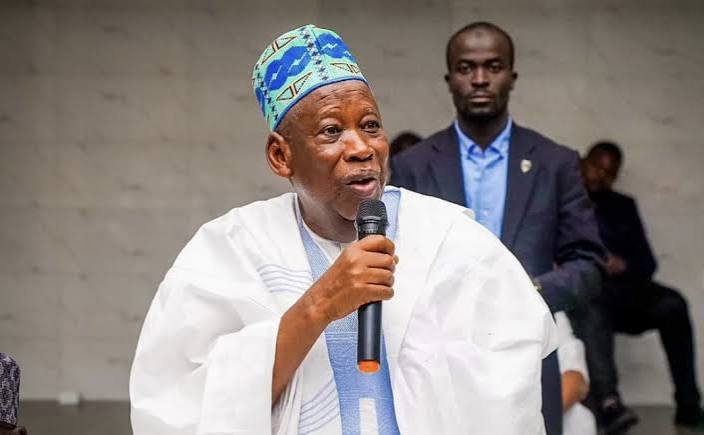
Former National Chairman of the All Progressives Congress, Abdullahi Ganduje, has described the Peoples Democratic Party as a defunct political party while calling on Nigerians to strengthen their commitment to national unity.
Ganduje made the remarks on Wednesday at the annual conference of the Forum of Former Deputy Governors of Nigeria in Abuja, where he referred to former Delta State Governor and ex-PDP vice-presidential candidate, Ifeanyi Okowa, as his elder brother.
Introducing Okowa, the former Kano State governor said, “My big brother, the former governor of Delta State and a former vice presidential candidate of the defunct party, PDP.”
Ganduje’s description of the PDP as defunct comes amid political realignments ahead of the 2027 general elections.
Speaking on nation-building, the former APC national chairman questioned whether Nigerians genuinely believed in the country’s unity and regarded its ethnic and cultural diversity as an advantage.
“On the issue of nation-building, we have to believe in our nation. Do we actually believe in our nation, Nigeria? Do we actually believe that our diversity is an asset and not a liability? The way we are moving, our diversity is becoming a liability,” he said.
Ganduje also reflected on Nigeria’s colonial history, arguing that Britain’s decision to unite the country’s diverse communities was primarily driven by economic interests rather than a desire to build a strong and united nation.
According to him, the colonial administration sought to exploit Nigeria’s natural resources to support industrial development in Britain.
“The colonial masters, when they came to Nigeria through missionary and other routes, they found us and our old system of governance. And in order to promote protection in their own country, they decided to put us together so that we can work and produce raw materials for their own industrial development,” he said.
He added that “their primary objective” was not to bring Nigerians together to build a stronger country.
The former Kano governor, however, commended Nigeria’s First Republic political leaders for promoting nationalism and organising political movements that eventually secured independence from Britain.
“We need to thank our First Republic politicians who developed a sense of nationalism in order to get independence, form political parties, and they succeeded in getting our independence,” Ganduje said.
He also expressed gratitude that Nigeria achieved independence without the kind of armed struggle experienced by some other countries.
“We are so lucky that we didn’t carry arms like other nations to get independence,” he added.
Ganduje’s comments highlighted the need for Nigerians to develop a stronger sense of patriotism and view the country’s diversity as an asset rather than an obstacle to national development.