




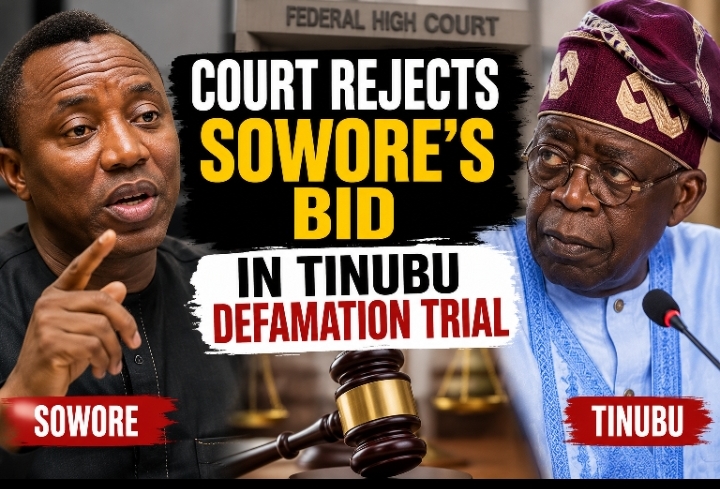
The Federal High Court in Abuja on Monday declined a request by former presidential candidate of the African Action Congress (AAC), Omoyele Sowore, seeking a lengthy adjournment in his ongoing trial over alleged defamatory remarks against President Bola Tinubu.
Justice Mohammed Garba Umar ruled against the application after the Department of State Services (DSS), which instituted the case, opposed the request, arguing that it would further delay proceedings that have already suffered multiple adjournments.
Sowore is facing charges over allegations that he described President Tinubu as a criminal on his social media platforms.
At the resumed hearing, his counsel, Reuben Adakole, informed the court that the defence was seeking an adjournment until after the judiciary’s annual vacation, citing the absence of Sowore’s lead counsel, Olumide Fusika (SAN), who was reportedly out of the country attending to family matters.
However, counsel to the DSS, Akinlolu Kehinde (SAN), opposed the application, contending that the defendant had previously secured several adjournments and that granting another lengthy postponement would undermine the accelerated hearing earlier ordered by the court.
Kehinde told the court that no fewer than 10 adjournments had already been granted at the instance of the defendant, adding that the Administration of Criminal Justice Act (ACJA) 2015 encourages speedy determination of criminal matters.
According to him, approving a two-month adjournment would run contrary to the court’s earlier directive for day-to-day hearing of the case.
In a brief ruling, Justice Umar agreed with the prosecution and dismissed the application, maintaining that proceedings should continue in line with the accelerated hearing order already in place.
The judge subsequently fixed July 16 for the continuation of Sowore’s defence.
Earlier during the proceedings, a lawyer and activist, Deji Adeyanju, who testified as a defence witness, told the court that President Tinubu had, during an official engagement in Benue State, affirmed the rights of citizens to criticise public office holders as part of democratic governance.
Adeyanju said the President had also emphasised the need for the judiciary to serve as a protector of citizens’ rights rather than an instrument of oppression.
Video clips of the President’s remarks were played in open court during the hearing.
Under cross-examination, Adeyanju acknowledged that he had previously served as Sowore’s lawyer but later withdrew from that role.
He also admitted making public comments on social media regarding arrests and prosecutions based on his personal experiences.
The witness, however, conceded that President Tinubu did not suggest that individuals who violate the law should be exempt from legal consequences.
The matter was adjourned until July 16 for the continuation of the defence case.