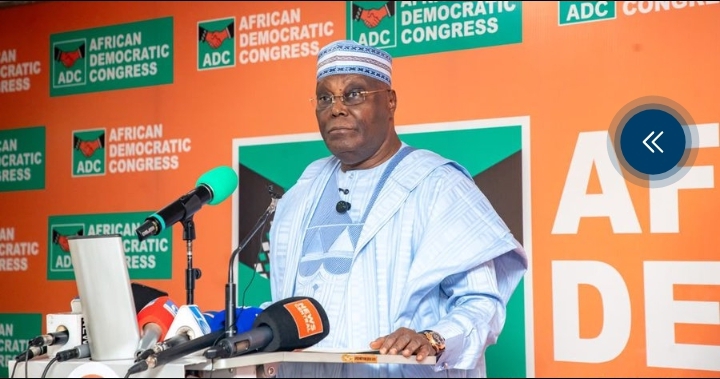
The presidential candidate of the African Democratic Congress, Atiku Abubakar, has challenged President Bola Tinubu’s claim that Nigeria has entered an “age of prosperity”, arguing that the government’s account of economic recovery does not reflect the daily realities of millions of Nigerians.
Atiku, a former Vice-President, made the remarks in his Independence Day address delivered at the ADC headquarters in Abuja on Thursday to mark Nigeria’s 66th anniversary.
He criticised the Tinubu administration over the rising cost of living, insecurity and public spending, while also outlining his proposed approach to fuel subsidy and calling for stronger protection of political freedoms.
Here are four key issues raised by Atiku in his address:
1. ‘Where is the prosperity?’
Atiku directly challenged Tinubu’s declaration that Nigeria had moved beyond the period of economic emergency into an “age of prosperity”.
“A President may announce a new chapter in a speech. He cannot announce food onto a family’s table or money into a worker’s pocket. Bola, where is this prosperity?” Atiku asked.
He argued that falling inflation did not necessarily mean that Nigerians had recovered the purchasing power lost to years of rising prices.
“A slower rise in prices does not restore what families have lost,” he said, adding that economic growth and rising exports should ultimately translate into improved living conditions for citizens.
2. Fuel subsidy and cost of living
The ADC candidate also criticised the removal of the petrol subsidy, arguing that the policy was implemented without adequate protection for households affected by the resulting increase in fuel and transportation costs.
Atiku said the government had promised that savings from subsidy removal would benefit Nigerians but questioned what had happened to those savings.
“Three years later, the pain has an address in every home. Bola, where is the benefit?” he asked.
He also proposed a capped and budgeted production subsidy tied to verified fuel refined in Nigeria, including output from modular refineries, with the costs published and independently audited.
3. Insecurity and government spending
Atiku linked the economic hardship to the security crisis, saying armed groups had continued to kill and displace Nigerians, while farmers faced difficulties accessing their farms and families remained vulnerable to kidnapping and ransom demands.
“A government that cannot make life affordable and cannot protect life has failed the two tests that matter most to its people,” he said.
He also questioned government expenditure and called for greater transparency in public spending, including disclosure of how borrowed funds and other public resources were being used.
4. Political freedom and the 2027 election
Atiku also used the Independence Day address to call for the protection of political freedoms ahead of the 2027 general elections.
He said Nigerians should be free to question their leaders, organise peacefully and demand political change without intimidation.
“Public office belongs to the people. No President owns the voices of citizens,” he said.
Atiku urged voters to scrutinise the programmes and promises of all political candidates and protect their votes, stressing that Nigerians should have the freedom to determine the direction of the country through the ballot.