





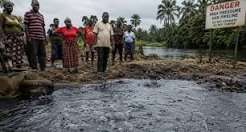
The Nigerian Upstream Petroleum Regulatory Commission (NUPRC) has identified 13 high-risk oil and gas wells around gas seepage locations in Bille community, Degema Local Government Area of Rivers State, raising concerns over the safety of residents and the possibility of an evacuation if the source of the emissions is traced to natural geological activity.
The regulator classified three of the 28 wells examined as very high risk, while 10 others were rated high risk. The remaining 15 were placed in the medium-to-low-risk category.
The findings were disclosed on Friday by the commission’s Director of Subsurface Development, Joseph Ogunsola, during a technical presentation at the 44th Annual International Conference and Exhibition of the Nigerian Association of Petroleum Explorationists in Abuja.
Ogunsola, who was represented by the Senior Manager, Onshore Frontier Development Drilling, Azibamikiomam John-Adumo, said a technical team had been constituted to investigate the unusual gas emissions and establish the conditions beneath the affected locations.
According to him, the assessment considered the proximity of existing wells to the seepage points and the nature of the underground reservoirs encountered during drilling operations.
The investigation team physically inspected 14 of the 28 wells identified, although three others could not be accessed because they were submerged.
During the inspections, officials reportedly observed gas escaping with a hissing sound from some facilities, while other installations showed signs of corrosion and vandalism.
One of the wells under investigation was originally drilled in search of crude oil but was subsequently shut down after gas, rather than oil, was discovered.
Ogunsola disclosed that the abandoned well was approximately 2.5 kilometres from one of the seepage locations, with other nearby wells situated between 2.5 and three kilometres from the affected points.
He said investigators were examining whether the emissions originated from the abandoned well or other nearby facilities, noting that Bille and its surrounding areas were extensively explored and contained significant hydrocarbon deposits.
The commission also warned that residents could face evacuation if scientific investigations establish that the seepage was caused by an underlying geological phenomenon.
Such a finding, according to the regulator, could complicate efforts to control the underground movement of gas because identifying its migration pathways and implementing effective containment measures would be more difficult.
To establish the actual source of the emissions, the NUPRC has commenced an independent scientific fingerprinting exercise involving Gas Chromatography-Isotope Ratio Mass Spectrometry and compositional field analysis.
The results of the exercise are expected in the fourth quarter of 2026 and are intended to determine the origin and composition of the escaping gas.
The latest development comes amid growing concerns over the environmental and health implications of the seepage, which was first reported in October 2025.
Residents have reported gas bubbling through rivers, swamps, boreholes and other water sources, raising fears about drinking water contamination, fire outbreaks and the safety of the community.
In an earlier assessment disclosed during a Federal Government visit to Bille in July, the NUPRC Chief Executive, Oritsemeyiwa Eyesan, said preliminary findings indicated that the community’s first aquifer had been contaminated.
“Our assessment indicates that the first aquifer has been contaminated, and while we work towards a sustainable long-term solution, we will provide potable water as quickly as possible,” Eyesan said.
The Federal Government delegation, led by the Minister of State for Petroleum Resources (Gas), Ekperikpe Ekpo, had promised affected residents potable water, medical outreach, firefighting equipment and other humanitarian assistance.
The National Emergency Management Agency also distributed relief materials to affected residents in October as the government continued its intervention.
However, the persistent emissions have continued to attract concerns from environmental organisations and community stakeholders, particularly over the potential dangers to public health, water sources and livelihoods in the predominantly fishing community.
The NUPRC said it was working with industry operators and other relevant stakeholders to establish the source of the seepage and determine appropriate measures to address the situation.