




President Bola Tinubu has announced a shift in his administration’s economic priorities from stabilisation to wealth creation, industrial expansion and improved living standards, declaring that Nigeria has overcome the emergency phase of its economic reforms.
The President said the next stage of the government’s programme would concentrate on translating recent macroeconomic improvements into tangible benefits for households and businesses, with a target of growing the economy to $1 trillion by 2030.
Tinubu, who outlined the new direction through the Speaker of the House of Representatives, Tajudeen Abbas, said the administration was now positioned to pursue broader economic opportunities after taking difficult decisions to address longstanding structural weaknesses.
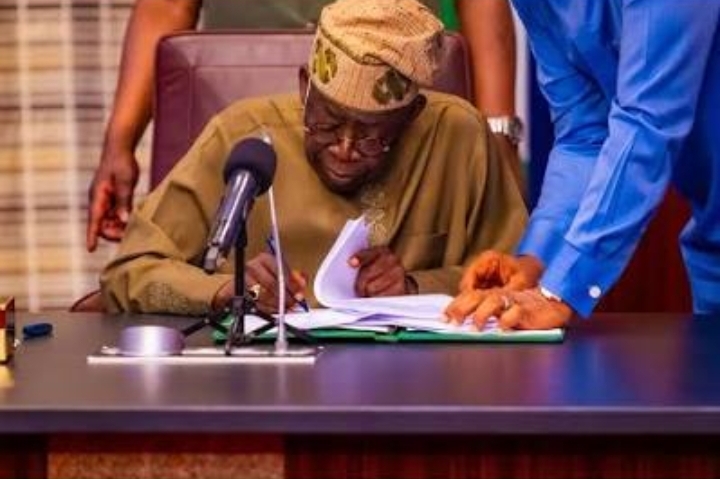
He spoke on Thursday at the presentation of a book titled Economic Diversification and Structural Transformation in Nigeria: The Past, The Present, The Future, written by a member of the House of Representatives, Abdulmumini Kofa, at the State House Conference Centre, Abuja.
The President, who authored the foreword to the publication, said the economic programme for the next phase would prioritise increased domestic production, employment generation, electricity supply, affordable housing and stronger private-sector participation.
According to him, the ambition of building a $1 trillion economy by 2030 would be pursued under the Medium-Term National Development Plan 2026–2030, with the private sector expected to provide 86 per cent of the investment required to achieve the target.
Tinubu said indicators of economic recovery included the growth of non-oil activities, increased foreign reserves and improved export earnings.
He disclosed that non-oil sectors now accounted for approximately 96 per cent of Nigeria’s Gross Domestic Product, while non-oil exports had exceeded $6bn.
The President also put the country’s external reserves at about $55bn, representing more than 14 months of import cover.
He further disclosed that non-oil revenue increased from N13.63tn in 2023 to N16.4tn in the first half of 2026.
Despite acknowledging the difficulties Nigerians had experienced during the reform process, Tinubu maintained that the administration’s decisions were necessary to reposition the economy for sustainable growth.
He said the next phase would be judged not merely by economic statistics but by the extent to which improvements translated into better conditions for ordinary citizens.
The President’s declaration comes amid continuing concerns over the cost of living, unemployment, weak purchasing power and the difficulties confronting businesses.
Meanwhile, Anambra State Governor, Chukwuma Soludo, has cautioned that Nigeria’s ambition of becoming a $1 trillion economy could remain out of reach without a significant acceleration in economic growth and investment.
Soludo argued that the country’s current growth rate of approximately four per cent was inadequate to drive the level of industrialisation required to reduce poverty and generate sufficient employment for its rapidly expanding population.
While acknowledging that the Tinubu administration had restored some measure of macroeconomic stability, the governor said the country needed to move beyond modest growth and pursue a more ambitious economic transformation agenda.
He advocated double-digit economic growth, supported by investments exceeding 30 per cent of GDP, sustained industrial development and policies capable of maintaining economic progress beyond electoral cycles.
The former Governor of the Central Bank of Nigeria also questioned the country’s fiscal capacity to finance the infrastructure and productive investments required for such transformation.
Soludo observed that Nigeria’s N68tn budget translated to approximately N772 per citizen daily, arguing that the figure exposed the limitations of the government’s revenue base relative to the country’s development needs.
He maintained that Nigeria could not achieve meaningful structural transformation without substantially increasing its capacity to generate revenue and attract investment.
Speaking on the theme, Speeding Up and Building to Last, the Anambra governor said the country had lost considerable time in its development journey and could no longer afford a slow pace of economic transformation.
He stressed the need for stronger industrialisation, a competitive exchange-rate framework and sustained investment in productive sectors to improve the country’s economic prospects.
The positions presented by Tinubu and Soludo highlighted the opportunities and challenges surrounding Nigeria’s $1 trillion economic ambition, particularly the need to ensure that macroeconomic stability translates into increased production, employment and improved welfare.
While the Federal Government is projecting a new phase of shared prosperity following its reform programme, Soludo’s intervention underscores the scale of investment and growth required to make that ambition achievable.