




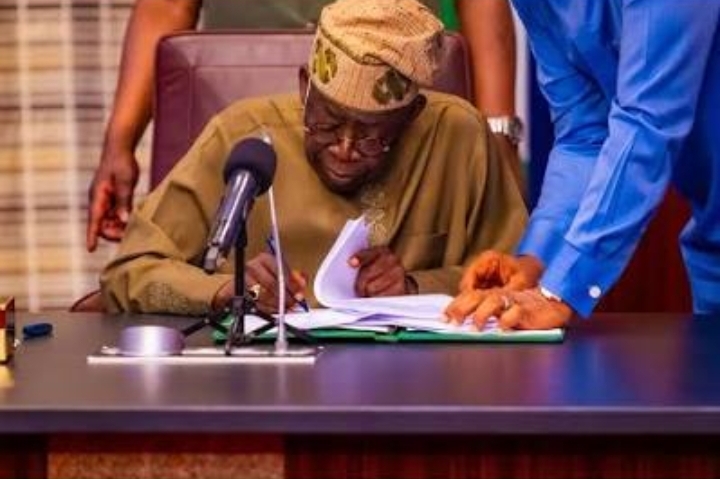
President Bola Tinubu has introduced a guaranteed minimum monthly pension of N52,500 for eligible retirees under the Contributory Pension Scheme, alongside a new healthcare programme aimed at shielding vulnerable pensioners from medical expenses.
The two initiatives, unveiled under the Presidential Pension Security Initiative in Abuja, are designed to strengthen retirement security and address longstanding challenges confronting Nigerian pensioners.
Tinubu, who was represented at the ceremony by Senate President Godswill Akpabio, said the Minimum Pension Guarantee Scheme would end more than two decades of delay in implementing a provision of the Pension Reform Act.
He maintained that Nigerians who devoted their productive years to national service deserved financial protection and access to essential healthcare after retirement.
“From this day, there is a floor beneath the Nigerian retiree. No one who contributed under the Contributory Pension Scheme will ever be allowed to fall below, not because this government is generous, but because it is your right,” the President declared.
The President challenged Nigerians to assess his administration based on its record in pension reforms rather than political promises, noting that successive governments had failed to translate the minimum pension provision into reality.
He said the guarantee, originally provided for under the Pension Reform Act 2004 and retained in the 2014 legislation, had remained largely unimplemented for 22 years because of the absence of dedicated funding.
According to him, the new arrangement would be administered by the National Pension Commission (PenCom) and take immediate effect.
The President also announced the introduction of PenCare, a pension industry-funded healthcare initiative that will provide eligible low-income retirees with essential medical services at no cost.
Explaining the importance of the programme, Tinubu said healthcare expenses had become a major threat to the financial stability of elderly Nigerians, with some retirees forced to spend a substantial portion of their pensions on medical treatment.
“A pension that cannot pay for medicine is not a pension; it is a receipt,” he said.
He added that the programme would help prevent medical emergencies from wiping out the savings accumulated by retirees during their years of service.
The President disclosed that the first healthcare access cards would be distributed to beneficiaries in the coming months.
Meanwhile, PenCom Director-General, Omolola Oloworaran, revealed that 173,209 retirees had been identified as eligible beneficiaries of the N52,500 minimum monthly pension guarantee.
She explained that more than N400bn had been provided through the Pension Protection Fund to finance the initiative.
Oloworaran said the beneficiaries comprised 34 per cent of retirees from the Federal Government, 12 per cent from state governments and 54 per cent from the private sector.
She stressed that the N52,500 threshold was determined through an actuarial assessment and would be reviewed periodically to maintain its relevance.
“The minimum pension in the Federal Republic of Nigeria is N52,500 every month. The figure was not cut from the air. It has been validated by an actuary, and it is subject to review,” she said.
On the healthcare initiative, the PenCom chief disclosed that the pension industry had committed more than N7bn to PenCare, with health insurance premiums already paid for nearly 30,000 retirees.
She described the arrangement as a funded intervention intended to reduce the healthcare burden on pensioners whose retirement earnings were insufficient to meet rising medical costs.
Oloworaran further disclosed that the Federal Government had inherited pension liabilities exceeding N2tn, but had facilitated the settlement of N1.07tn.
She added that 13 states had either cleared their inherited pension obligations, had no outstanding legacy liabilities or had settled at least 80 per cent of their arrears.
The commission also announced plans to extend pension coverage to millions of Nigerians working outside the formal employment sector, including traders, farmers, artisans and commercial transport operators.
According to Oloworaran, accredited pension agents would be deployed to markets, motor parks and communities to encourage informal-sector workers to participate in the scheme.
In another development, she disclosed plans to mobilise $750m through an infrastructure investment programme involving the pension industry and development partners.
The proposed arrangement is expected to provide long-term financing for infrastructure projects, with an initial $250m tranche comprising $200m from the pension industry and $50m from development partners.
The pension reforms come amid growing concerns over the welfare of retired workers, particularly members of the Contributory Pension Scheme.
The development also coincides with renewed protests by retired police officers under the scheme, who have been demanding changes to their pension arrangements and the implementation of an alternative payment structure.
The protesting retirees have threatened to sustain their action until the Federal Government addresses their grievances and fulfils previous commitments.
The latest initiatives are expected to provide additional financial and healthcare protection for eligible retirees, although their effectiveness will depend on sustained funding, transparent administration and proper implementation.