






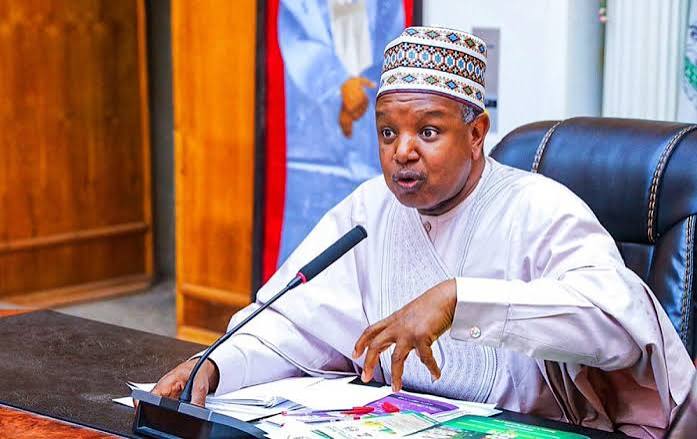
Minister of Budget and Economic Planning, Senator Atiku Bagudu, says President Bola Tinubu is pursuing an ambitious economic agenda aimed at growing Nigeria into a $2 trillion economy, arguing that the country possesses the resources and potential to achieve such a milestone.
Bagudu said Nigeria should not set limits on its economic aspirations, noting that the achievements of countries such as Brazil demonstrated what could be accomplished with the right policies and leadership.
The minister spoke on Tuesday in Abuja during the unveiling of the All Progressives Congress (APC) 2027 presidential campaign manifesto, titled From Reform to Prosperity, which outlines the party’s policy direction for 2027 to 2031.
According to him, Tinubu believes Nigeria can attain the economic standing of Brazil, whose economy is valued at approximately $2 trillion.
“For Mr President, if Brazil can be a $2 trillion economy, why not Nigeria? Let me repeat, maybe the journalists may not care. This is how profound his thinking is: why not Nigeria?” Bagudu said.
He maintained that the President’s economic vision was informed by the conviction that Nigeria had sufficient human and natural resources to achieve greater economic prosperity if appropriate policies were consistently implemented.
The minister also defended the administration’s economic reforms, arguing that difficult decisions were necessary to address longstanding structural problems and place the country on a sustainable growth path.
He said Tinubu had demonstrated the political will to confront economic challenges rather than avoid difficult choices for immediate political gains.
However, Bagudu acknowledged that the government needed to intensify efforts to ensure that the gains from its economic policies translated into tangible improvements in the lives of ordinary Nigerians, particularly vulnerable citizens and young people.
He emphasised that economic growth should ultimately improve living conditions and provide better opportunities for Nigerians.
Meanwhile, Minister of Industry, Trade and Investment, Jumoke Oduwole, disclosed that the Federal Government was targeting annual non-oil exports of at least $15bn, alongside the creation of one million export-related jobs by 2031.
She also said the government planned to establish an anchor industrial cluster in each of the country’s six geopolitical zones and increase manufacturing’s contribution to the Gross Domestic Product to at least 12 per cent.
Oduwole explained that the targets were designed to strengthen local production, expand export opportunities and generate employment.
Also speaking, Chief of Staff to the President, Femi Gbajabiamila, defended the administration’s economic policies, particularly the removal of petrol subsidy and the unification of the foreign exchange market.
Gbajabiamila said Tinubu had chosen to take decisions with long-term national benefits despite the immediate economic difficulties experienced by Nigerians.
“The difference between a politician and a leader is that while a politician thinks about the next election, a leader thinks about the next generation,” he said.
He acknowledged that the reforms had placed considerable pressure on households but argued that postponing necessary economic decisions would have further weakened the country’s ability to address its development challenges.
The APC manifesto outlines the party’s commitments in critical sectors, including energy, infrastructure, agriculture, industrial development and social welfare, ahead of the 2027 general election.




