






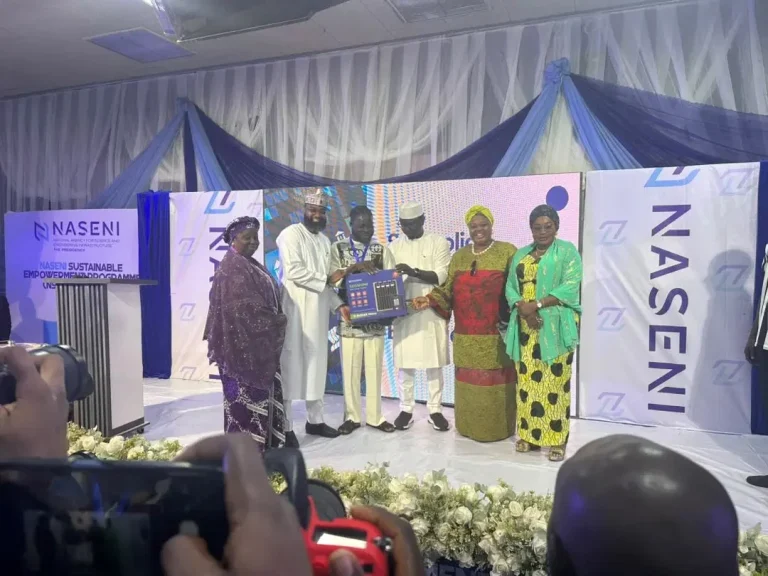
The Federal Government has provided locally manufactured household equipment to 330 residents of Ondo State under the Sustainable Empowerment Programme of the National Agency for Science and Engineering Infrastructure (NASENI).
The beneficiaries, drawn from the state’s 18 local government areas, received items including solar home systems and clean cooking stoves as part of efforts to promote indigenous technology, improve living conditions and stimulate local manufacturing.
Speaking during the distribution exercise on Saturday, NASENI’s Executive Vice Chairman and Chief Executive Officer, Khalil Halilu, said the initiative was aimed at converting research and technological innovations into practical solutions that address everyday challenges.
He urged Nigerians to embrace locally developed products, noting that increased patronage of indigenous technology would boost domestic production, generate employment and create economic opportunities.
“This is to promote locally produced items which bring about employment and also to have something good for our communities,” Halilu said.
He added that the agency’s mandate could only be fully achieved when its innovations translated into tangible benefits for households and businesses.
“Our mandate finds its fullest meaning when technologies we develop and promote help people solve real problems, become more productive and improve their standards of living,” he stated.
Halilu explained that the solar home systems would provide electricity for domestic lighting, enable schoolchildren to study at night and support small businesses.
He said the clean cooking stoves would provide more efficient cooking alternatives and help reduce exposure to harmful smoke when properly used.
The NASENI chief executive disclosed that the empowerment programme had extended to more than 10 states across the country’s six geopolitical zones, with 330 men and women benefiting from the intervention in Ondo.
He said the initiative was designed to make locally developed technologies accessible to ordinary Nigerians rather than restricting their benefits to research institutions.
Also speaking, the Minister of Youth Development, Ayodele Olawande, announced that the beneficiaries would receive additional financial assistance to establish new businesses or expand existing ones.
Olawande described the intervention as an effort to extend technological innovations and economic opportunities to communities at the grassroots, rather than a political initiative.
He said the clean cooking stove component would particularly benefit women who rely on firewood and other traditional cooking methods, which expose them and their children to smoke.
The minister also announced that the Federal Government would commence the Nigeria Youth Academy programme on November 9 to promote innovation, entrepreneurship and skills development among young Nigerians.
He further disclosed that beneficiaries of some related government interventions had received grants of ₦20m, ₦10m and ₦5m to support their businesses and innovative ideas.
“The Federal Government is working with relevant agencies and stakeholders to extend technology, mentorship and entrepreneurship opportunities to young people and vulnerable groups,” Olawande said.




