




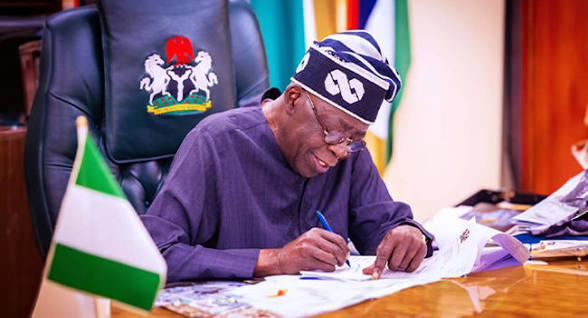
President Bola Tinubu has asked the National Assembly to approve a fresh external borrowing plan worth $20.52bn and €1.05bn to finance infrastructure and development projects across the country.
The request, covering the 2026–2027 Supplementary External Borrowing Plan, was conveyed in a letter read by Senate President Godswill Akpabio during plenary on Tuesday.
According to the President, the proposed loans would support projects in infrastructure, agriculture, healthcare, education, water supply, security and employment generation, as well as reforms in public financial management.
Tinubu said the projects were selected based on technical and economic assessments, with consideration given to their potential contributions to Nigeria’s socio-economic development.
“I want to emphasise that the projects and programmes included in the Borrowing Plan were selected based on thorough technical and economic evaluation, as well as their anticipated contribution to the socio-economic development of the country,” he said.
The President explained that the proposed investments were also intended to create jobs, promote skills acquisition and entrepreneurship, reduce poverty and strengthen food security.
“These initiatives aim to generate employment, promote skills acquisition, foster entrepreneurship, reduce poverty and enhance food security, all of which improve the livelihood of the Nigerian child,” Tinubu said.
He noted that most of the projects would be implemented across Nigeria’s 36 states and the Federal Capital Territory.
The President said the country’s infrastructure deficit and the substantial funding required to address it had made additional external borrowing necessary.
“In light of the need for significant infrastructure investment in the country and the vast financial resources needed to address this gap, it has become essential to pursue broader external borrowings to close the financing shortfall,” he stated.
Tinubu identified power, transportation and healthcare as some of the critical sectors expected to benefit from the proposed financing.
He urged the National Assembly to approve the borrowing plan to enable the government to meet its financial commitments and ensure timely implementation of the proposed projects.
“Given the urgent nature of these needs and the importance of stabilising the country, it is crucial to seek the consideration and approval of the National Assembly leadership and the entire National Assembly for the 2026–2027 Supplementary External Borrowing Plan,” the President said.
“This will enable the government to fulfil its obligations to the Nigerian people through timely disbursements and effective project implementation.”
Following the presentation of the letter, Akpabio referred the request to the Senate Committees on Local and Foreign Debts and Appropriations for further scrutiny.
He directed the committees to submit their reports within one week.
The latest request comes about five months after the National Assembly approved a $516.3m loan from Deutsche Bank AG to finance the construction of the Sokoto–Badagry Superhighway, a major infrastructure project under the Tinubu administration’s Renewed Hope Agenda.
The facility has a nine-year tenure, including a grace period of up to three years, with an interest rate capped at the Chicago Mercantile Exchange’s Secured Overnight Financing Rate plus 5.3 per cent annually.
The loan is backed by insurance from the Islamic Corporation for the Insurance of Investment and Export Credit, the insurance arm of the Islamic Development Bank.
In March, the National Assembly also approved a $6bn external borrowing plan for the Federal Government.
Under the arrangement, $5bn was to be sourced from First Abu Dhabi Bank to support the national budget, while a $1bn export finance facility arranged by Citibank was earmarked for the rehabilitation of Tin Can Island Port and the Lagos Port Complex.
The fresh borrowing request comes amid concerns about Nigeria’s rising public debt and the increasing proportion of government revenue devoted to servicing existing obligations.
The Federal Government has relied on domestic and external borrowing to finance budget deficits and infrastructure development in recent years.
Although Nigeria’s debt-to-GDP ratio has generally been considered moderate compared with that of some peer economies, concerns persist over the country’s limited revenue base and its capacity to meet debt obligations without constraining spending on essential services.
A substantial portion of government revenue goes towards debt servicing, reducing the funds available for infrastructure, healthcare, education and other development priorities.
The International Monetary Fund and the World Bank have repeatedly urged Nigeria to strengthen revenue mobilisation, improve tax collection and ensure that borrowed funds are directed towards productive investments capable of generating economic returns.
The Federal Government, however, has maintained that external borrowing remains necessary to address infrastructure deficits, finance development projects and meet budgetary obligations.
Government officials have also argued that borrowing on favourable terms can help manage financing costs and support economic growth.