






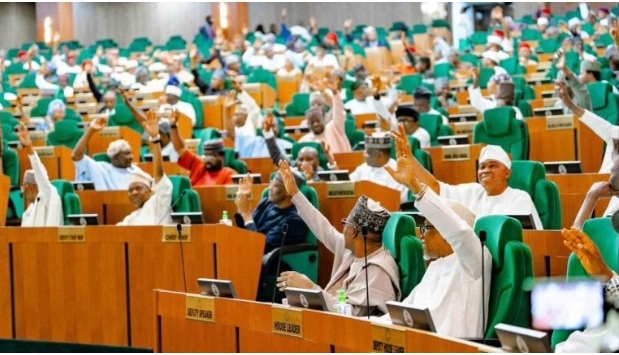
President Bola Tinubu has asked the House of Representatives to consider three executive bills seeking to overhaul Nigeria’s drug enforcement laws, expand the investigative powers of the Nigerian Safety Investigation Bureau and replace the Administrative Staff College of Nigeria with a National School of Government.
The proposed legislations were transmitted to the House in three separate letters dated October 12, 2026, which Speaker Tajudeen Abbas read during plenary on Thursday.
The letters, marked restricted, were received by the Office of the Speaker on October 13.
Tinubu, who invoked Section 58(2) of the 1999 Constitution, as amended, in transmitting the proposals, urged lawmakers to give the bills “expeditious consideration.”
The three proposals cover the National Drug Law Enforcement Agency, the Nigerian Safety Investigation Bureau and the establishment of a new institution for leadership development and executive capacity building in the public service.
Under the proposed NDLEA Bill, 2026, the President seeks to repeal the existing National Drug Law Enforcement Agency Act and the Indian Hemp Act, both contained in the Laws of the Federation of Nigeria, 2004, and consolidate their provisions under a single legal framework.
In his letter to the lawmakers, Tinubu said the legislation would establish a unified system for enforcing laws against illicit drugs and strengthen the agency’s investigative responsibilities.
The President explained that the proposed law would “enact a consolidated framework to enforce the law against the cultivation, processing, sale, trafficking and use of hard drugs.”
He added that the legislation would “empower the Agency to investigate persons suspected to have dealings in drugs.”
The proposed reform is expected to bring provisions currently scattered across separate statutes into one legislative framework governing the agency’s operations.
The NDLEA is responsible for combating illicit drug production and trafficking, investigating drug-related offences and enforcing laws regulating controlled substances.
The second proposal seeks to broaden the mandate of the Nigerian Safety Investigation Bureau beyond aviation accidents and incidents to cover other modes of transportation.
The NSIB Bill, 2026, proposes amendments to the Nigerian Safety Investigation Bureau (Establishment) Act, 2022, to enable the agency to investigate safety occurrences involving rail, maritime and other transport sectors.
Tinubu said the amendment was intended to “reposition the Bureau as an independent multimodal safety investigation authority” and expand its responsibilities beyond aviation.
According to the President, the proposed changes would also transfer supervisory oversight of the bureau to the Presidency and strengthen its institutional, operational and administrative structures.
The proposed expansion would bring investigations into accidents and incidents across different transportation systems within the bureau’s statutory responsibilities, subject to the provisions of the amended law.
Established under the 2022 Act, the NSIB investigates accidents and incidents, determines their causes and issues safety recommendations aimed at preventing similar occurrences.
The third bill seeks to repeal the Administrative Staff College of Nigeria Act, Cap A4, Laws of the Federation of Nigeria, 2004, and establish a National School of Government, Nigeria.
The proposed National School of Government Bill, 2026, is designed to create a national institution focused on leadership development, policy implementation and capacity building for government executives.
Tinubu said the legislation would “establish the National School of Government, Nigeria, as a national institution for leadership, development, policy delivery and executive capacity building.”
The proposed institution would provide a broader framework for developing leadership skills and strengthening the ability of public officials to formulate and implement government policies.
ASCON currently provides management training, research and consultancy services for public- and private-sector organisations, including programmes aimed at improving administrative and managerial skills.
If the proposed legislation is passed, the new law will establish the statutory foundation for the National School of Government and define its functions and institutional arrangements.
The three bills will now proceed through the House of Representatives’ legislative process, including scrutiny by relevant committees and consideration by lawmakers.
Their transmission to the National Assembly does not mean the proposed changes have taken effect. The bills must pass through the required legislative and constitutional procedures before they can become law.




