




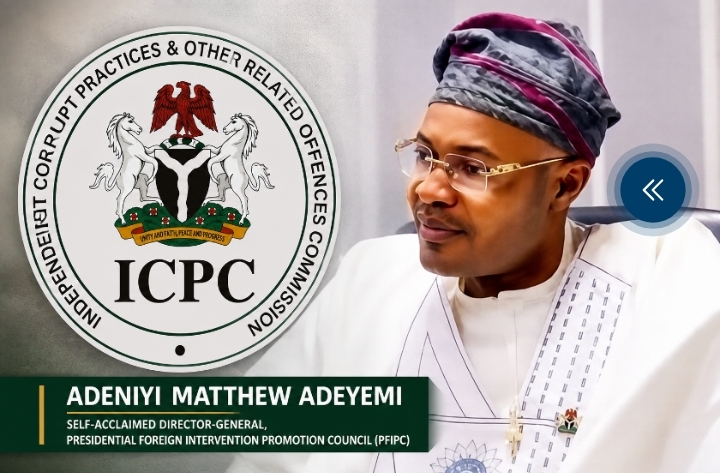
The House of Representatives Ad Hoc Committee investigating the purported Presidential Foreign Intervention Promotion Council has uncovered 58 bank accounts allegedly linked to its detained Director-General, Prince Adeniyi Adeyemi, as well as an alleged N400 million transaction suspected to have involved fraudulent representations.
The committee also said more than 30 of the accounts were allegedly operated in the names of about nine agencies, companies, foundations and other entities connected to Adeyemi.
Chairman of the committee, Yusuf Gagdi, disclosed the findings on Wednesday in Abuja while presenting the panel’s preliminary report on the circumstances surrounding the inclusion of the purported council in the Federal Budget Framework.
Gagdi said preliminary information obtained from financial and investigative institutions showed that the Bank Verification Number and other identifying details associated with Adeyemi were linked to a network of personal, corporate, organisational and foundation accounts.
Among the entities identified by the committee were the Confederation of United Nations Youths, FCT Investment Promotion Agency and Public-Private Partnership, FCT Investment Promotion Council and Public-Private Partnership, Foreign Investment Promotion Agency, United Nations Youth Global Agency, United Nations Youth Global Foundation and World United Nations Youth Global Foundation.
Others include World Entrepreneurship University Limited, World Enterprise University Limited, FCT Investment Promotion Act, FCT Promotion Agency and Olubadan of Ibadan Foundation.
However, Gagdi cautioned that the committee had yet to conclude that every account, entity or transaction identified during the investigation was unlawful.
He said the panel was still “reconciling registration records, account mandates, beneficial ownership information, signatories and transaction histories to establish the true nature and control of the organisations and accounts.”
According to him, preliminary findings showed “similarities in the nomenclature, objectives, management structures, signatories and banking relationships of several of the entities.”
He said the similarities had raised concerns about a possible pattern in which organisations could have been created or deployed to manufacture artificial credibility, solicit funds, obtain official recognition or induce members of the public to part with money.
ALLEGED N400M TRANSACTION
Of particular concern to the lawmakers was an alleged N400 million transaction involving a company which claimed that Adeyemi induced it to make payments in four instalments after allegedly representing that he could secure a contract for the renovation, furnishing or improvement of a purported official residence allocated to him as Director-General of the PFIPC.
Gagdi said the committee was tracing the destination of the funds and identifying account holders and beneficial owners to determine whether public officers or private individuals participated in, facilitated or benefited from the transaction.
He said the allegations, if established through competent investigative and judicial processes, could disclose offences including fraudulent misrepresentation, obtaining money by false pretence, impersonation, conspiracy, forgery and offences relating to the concealment or movement of proceeds of crime.
The committee also said its investigation had uncovered evidence suggesting that the PFIPC was never lawfully established.
According to Gagdi, the panel found no Act of the National Assembly, gazetted enactment, Presidential Executive Order or other lawful instrument establishing the purported council.
He said documentary materials used to project the existence and authority of the organisation contained evidence of alleged fabrication, forgery, mutilation, impersonation and unauthorised representation of institutions and public officers.
The committee also said it found “evidence of alleged fabrication of official documents, including a purported presidential appointment letter for Adeyemi, a purported Executive Order and a document presented as an Act of the National Assembly establishing the organisation.”
GBAJABIAMILA EXONERATED
The committee consequently cleared the Chief of Staff to the President, Femi Gbajabiamila, of allegations that he authorised, established or participated in the activities of the purported council.
According to Gagdi, evidence obtained from the State House established that the purported appointment letter was neither issued nor signed by Gbajabiamila.
The letterhead and reference number were also said to be inconsistent with official State House correspondence.
Gagdi said the documentary evidence before the committee did not implicate the Chief of Staff.
“The documentary evidence presently before the Committee does not establish that the Chief of Staff authorised, approved, established or participated in the activities of the purported organisation,” he said.
Rather, he said the evidence showed that Gbajabiamila took prompt steps after receiving alerts concerning the activities of the organisation.
“The evidence showed that Gbajabiamila promptly communicated with relevant security and investigative agencies, including the Nigeria Police Force, Office of the National Security Adviser, Department of State Services and Economic and Financial Crimes Commission, after receiving alerts concerning the activities of the organisation,” Gagdi said.
The committee also exonerated National Assembly committees responsible for budget scrutiny from culpability but said the investigation had shifted attention to how an entity that was allegedly not lawfully established secured apparent recognition and budgetary treatment within the Federal Government’s administrative machinery.
The development, the committee said, exposed weaknesses in the verification of government institutions, creation of administrative and budget codes, authentication of official correspondence, allocation of government accommodation and processing of official-looking vehicle number plates.
The purported council was also alleged to have strengthened its claim to government legitimacy by occupying office accommodation within the Federal Secretariat Complex and operating a website portraying itself as a Federal Government institution.
The committee further alleged that the organisation used the names, offices and photographs of President Bola Tinubu and other senior government officials without authorisation.
About 39 persons were also represented as employees of the purported organisation, with the committee investigating their recruitment, appointment letters, identity cards and remuneration.
The panel is also probing allegations that some prospective employees were required to make payments as a condition for employment.
COMMITTEE RECOMMENDATIONS
Gagdi said the committee had recommended that all Ministries, Departments and Agencies immediately refrain from recognising, transacting with or extending government privileges to the PFIPC or any related entity whose legal status had not been independently verified.
The committee further recommended that “no appropriation, administrative code, warrant, cash backing, financial release or governmental facility should be processed in favour of the purported organisation.”
It also called on financial institutions and investigative agencies to preserve account records, transaction histories, mandates and beneficial ownership information relating to persons and entities under investigation.
The panel urged “the prompt conclusion of criminal and financial investigations” and said that where sufficient admissible evidence was established, appropriate agencies should institute criminal proceedings before courts of competent jurisdiction.
It also recommended the tracing, preservation, freezing and recovery of proceeds or assets derived from any unlawful conduct established by investigators, subject to applicable legal requirements and judicial authorisation.
The committee commended the Nigeria Police Force, the Department of State Services, the Economic and Financial Crimes Commission, the Independent Corrupt Practices and Other Related Offences Commission and the Office of the National Security Adviser for their roles in tracing the alleged fabricated documents, associated entities, financial accounts and transactions.
It also proposed stronger authentication procedures for the creation of government institutions, administrative and budget codes and official correspondence purportedly originating from the Presidency and other high offices.
Another recommendation was the establishment or strengthening of a secure centralised digital verification platform through which the legal status and establishing instruments of Federal Government institutions could be independently authenticated.
The committee said the alleged N400 million transaction should be subjected to a separate and comprehensive investigation, including lawful steps to trace, preserve, freeze and recover any proceeds of unlawful activity established by investigators.
Gagdi said the panel would continue examining the ownership and control of the identified accounts, the alleged transaction, the purported official residence, special number plates, occupation of government accommodation and the roles played by public officers and private individuals connected with the matter.
He added that affected persons would be given fair hearing before definitive findings were reached.
The chairman stressed that the findings presented by the committee were preliminary and did not amount to a final determination of criminal guilt.
He said the final report would be submitted to the House upon its resumption from the two-month annual recess for lawmakers to consider, debate, adopt, amend or reject the findings and recommendations.
Gagdi said the investigation went beyond exposing a purported government agency or identifying an alleged mastermind.
“The Presidency cannot be impersonated with impunity,” he said, stressing that the identity, authority and instruments of the Federal Republic could not be appropriated by private individuals or organisations for personal advantage.
He assured that the committee’s final report would contain definitive findings, identified institutional and individual responsibilities and recommendations for appropriate legislative, administrative, disciplinary, civil, financial and prosecutorial action, subject to the decision of the House and due process of law.