




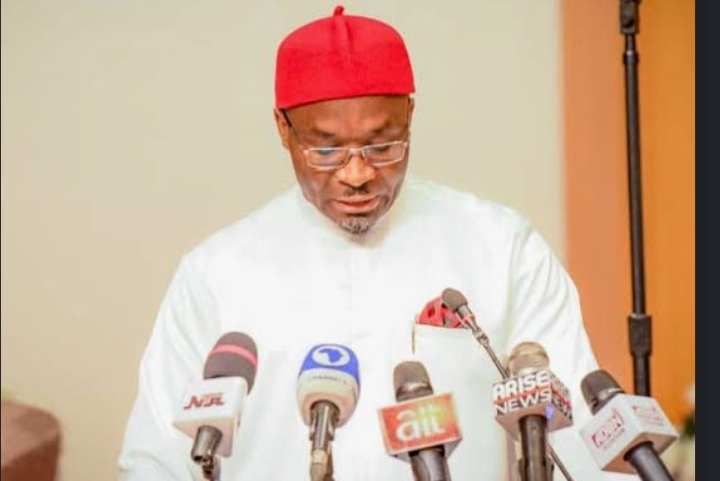
Deputy Speaker of the House of Representatives, Benjamin Kalu, has called for stronger collaboration between security agencies and local communities, saying residents often know where criminals hide and can provide vital intelligence if their identities are protected.
Kalu made the call on Thursday at the 2026 South-East Regional Security Summit themed “Collaborative Approaches to Strengthening Security and Regional Stability,” where he also urged the five South-East states to adopt a coordinated approach to tackling insecurity.
According to him, criminal groups operate across state boundaries, making regional cooperation and intelligence sharing essential to defeating terrorism, banditry and other violent crimes.
“Residents usually know when strangers enter their forests, when abandoned buildings become criminal camps or when unusual arms move through their communities. They will provide information only when they believe their identity will be protected and their reports will lead to responsible action,” Kalu said.
The Deputy Speaker urged security agencies to establish secure community-reporting channels, protect informants and strengthen collaboration with traditional rulers, town unions, youth organisations, women’s groups, transport unions and neighbourhood associations.
He also proposed the establishment of a permanent South-East Regional Security Coordination Council and a shared intelligence platform to improve information sharing and joint operations across the region.
“Criminal networks do not recognise state boundaries. Our response must therefore be regional,” he said.
Kalu explained that the proposed framework should include a joint intelligence-fusion mechanism, interoperable communication systems, coordinated patrols along inter-state routes, a shared database of wanted persons and harmonised procedures for rapid response.
He further urged security agencies to move beyond conventional checkpoint operations and adopt intelligence-led policing supported by modern technology.
“Checkpoints alone cannot defeat mobile and technologically enabled criminal groups. We require drones, geospatial mapping, forensic capability, automated vehicle identification, emergency communication systems and professionally managed surveillance infrastructure,” he said.
On the ongoing debate over state police, Kalu maintained that decentralised policing remains necessary but warned that it must not be abused.
“The proposed establishment of state police must be anchored on accountability, professionalism and service to the people. It must never become a tool for political repression,” he said.
He assured Nigerians that the National Assembly would continue to pursue constitutional amendments establishing state police while embedding safeguards to prevent political abuse.
Kalu also commended President Bola Tinubu for reforms aimed at strengthening the nation’s security architecture, including plans to expand the Nigerian Army from eight to 12 divisions and recruit about 28,000 additional personnel, saying the move would improve operational capacity and response to security threats.
He urged participants at the summit to ensure it produces practical outcomes, recommending that stakeholders develop a comprehensive regional operational security plan within 60 days and reconvene within six months to assess implementation.
“The outcome of this summit must go beyond speeches,” Kalu said, reaffirming the commitment of the House of Representatives to supporting security reforms through legislation, oversight and budgetary appropriations.