




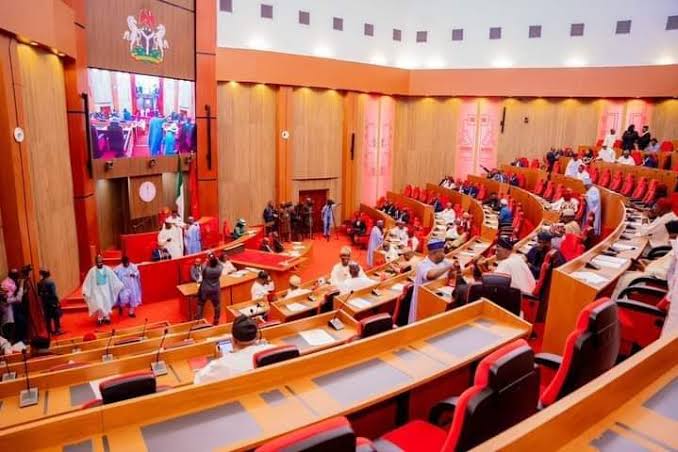
The Senate on Tuesday signalled a possible review of Nigeria’s diplomatic relations with South Africa over renewed xenophobic attacks targeting Nigerians, as lawmakers demanded stronger action to protect citizens living and doing business in the country.
The upper chamber issued the warning during plenary while debating a motion sponsored by Senator Asuquo Ekpeyong, who raised concerns over reports of a June 30 ultimatum allegedly directed at Nigerians residing in South Africa.
The development has reignited concerns over recurring xenophobic violence in Africa’s most industrialised nation, where Nigerian nationals have repeatedly been victims of attacks, killings, displacement and destruction of property.
During deliberations, senators urged the Federal Government to intensify diplomatic engagement with South African authorities and secure concrete guarantees for the safety of Nigerians.
Senator Salihu Mustapha (Kwara Central) argued that Nigeria could no longer remain passive in the face of repeated attacks on its citizens.
“We cannot continue to fold our arms while Nigerians are being killed and their businesses looted,” Mustapha said, urging a more robust response from the Federal Government.
The debate took a more dramatic turn when some lawmakers proposed tougher retaliatory measures if the attacks persist.
Senator Abdul Ningi suggested that President Bola Tinubu should begin considering the process of severing diplomatic ties with South Africa, while Senator Adams Oshiomhole advocated economic measures against South African businesses operating in Nigeria.
Oshiomhole maintained that profits generated by South African companies in Nigeria could be channelled towards compensating victims of xenophobic attacks.
“We can’t allow our people to suffer while South African investment and profit are being taken away here,” he said.
However, several lawmakers called for caution, warning against actions that could further strain relations between Africa’s two largest economies.
Former Senate Leader Yahaya Abdullahi argued that the attacks should be viewed within the broader political dynamics in South Africa, suggesting that certain groups may be exploiting anti-foreigner sentiments to weaken the country’s ruling establishment.
“This is a coordinated effort to destabilise the government of South Africa and to remove the ruling party, the ANC, from office,” Abdullahi said.
“We should tread with great caution and carefully consider this conspiracy.”
At the end of the debate, the Senate adopted a series of resolutions directing the Federal Government, through the Ministry of Foreign Affairs and the Nigerian High Commission in Pretoria, to obtain formal assurances from South African authorities regarding the safety of Nigerians.
Lawmakers also demanded the arrest and prosecution of those responsible for any attacks and instructed relevant agencies, including the Nigerians in Diaspora Commission (NiDCOM), to compile a comprehensive database of Nigerians affected by xenophobic violence for possible legal action and compensation claims.
In addition, the Senate called for collaboration with the African Union and other affected African countries to establish an early warning and accountability framework aimed at preventing future xenophobic attacks across the continent.
The chamber further mandated its Committees on Foreign Affairs and Diaspora Affairs to review the implementation of previous Senate resolutions on xenophobia and examine bilateral agreements between Nigeria and South Africa.
Deputy Senate President Barau Jibrin, who presided over the session, urged lawmakers to allow the committee complete its investigation before any far-reaching diplomatic or economic measures are considered.
“Nigeria leads Africa. We need to lead by example. Once we have well-informed facts, we can take action,” Barau said.
The Senate Committee on Foreign Affairs was subsequently directed to investigate the latest developments and submit its report within two weeks.
Lawmakers noted that while Nigeria remains proud of its historic support for South Africa’s anti-apartheid struggle, the country must equally ensure the protection of its citizens wherever they reside.