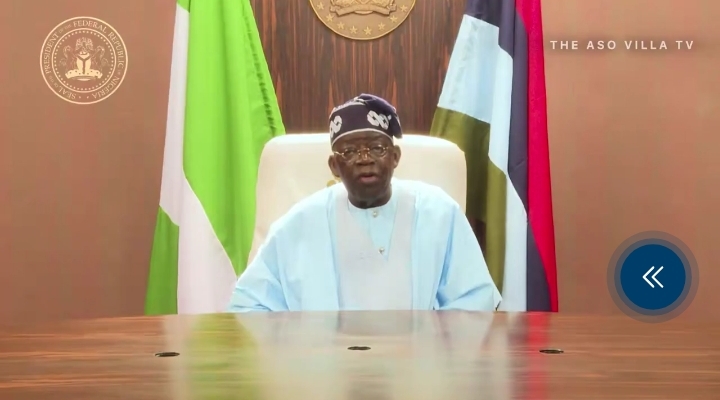
President Bola Tinubu has announced plans to provide 50,000 additional hostel bed spaces across federal tertiary institutions by the end of 2027 as part of efforts to address accommodation shortages and improve students’ welfare.
Tinubu made the pledge on Saturday during the commissioning of Block E of the College of Medicine Students’ Hostel at the University of Ibadan, Oyo State.
Represented by the Minister of Education, Tunji Alausa, the President said the initiative would be implemented under the N400bn Student Hostels Programme through the Tertiary Education Trust Fund and partnerships with private investors.
He said the programme was designed to provide students with safe and decent accommodation conducive to learning.
“My administration will deliver 50,000 new bed spaces across federal tertiary institutions by the end of 2027, through our N400bn Student Hostels Programme. Our purpose is to give more students safe, decent accommodation that supports their education,” Tinubu stated.
The President disclosed that the newly commissioned hostel would accommodate 192 medical and dental students in 48 rooms spread across four floors, with each room designed for four occupants.
He added that the facility was equipped with private toilets, showers, kitchenettes and four reading rooms to provide a comfortable learning environment for the students.
Tinubu explained that the College of Medicine had previously faced a shortage of 490 bed spaces, representing 44.5 per cent of its accommodation requirements, following a 2020 directive by the Medical and Dental Council of Nigeria requiring clinical students to reside within the University College Hospital premises.
According to him, the shortage exposed students to security challenges and limited the institution’s ability to utilise its admission quota fully.
The President also disclosed that more than 36 universities had benefited from the Renewed Hope Energising Education Programme, with power installations ranging from 2.5 to 12 megawatts.
He further said 20 Compressed Natural Gas conversion centres had been completed, while another 40 were expected to be delivered by the end of 2028.
“Reliable power supports laboratories, libraries, hostels and the clinical facilities on which medical education depends,” he said.
Earlier, the Vice-Chancellor of the University of Ibadan, Prof. Peter Olapegba, described the commissioning as another significant milestone in the institution’s efforts to improve accommodation for medical students.
He recalled that Blocks C and D, named after Philip Ozuah and T.Y. Danjuma, respectively, had also been commissioned as part of the hostel development initiative.
Olapegba expressed appreciation to the Chagoury brothers, Gilbert and Ronald, for their contributions towards the development of the facility.
“Our expectation is that the improved learning environment will contribute to producing healthcare professionals distinguished by competence, integrity and a strong sense of national responsibility,” he said.
In his remarks, the Provost of the College of Medicine, Prof. Temidayo Ogundiran, disclosed that the college accounted for about one-third of the university’s institutional footprint, while its researchers generated approximately 80 per cent of the institution’s research grant income.
Ogundiran also commended the Federal Government’s N110bn Special High Impact Intervention Project, launched in April 2025 to rehabilitate 18 medical schools across the six geopolitical zones through TETFund.
However, he appealed for additional government support to construct a 1,000-seat student auditorium, expand the college’s administrative building and complete hostel Blocks A and B.
The provost expressed concern over the institution’s rising energy costs, revealing that the college spent approximately N18m monthly on diesel and electricity supplied by the Ibadan Electricity Distribution Company.
“The college currently spends about N18m monthly on diesel and as payment to IBEDC for electric power supply. This expenditure is unsustainable and is placing severe pressure on our operations,” he said.
He consequently urged the Minister of Power, Joseph Tegbe, to facilitate the implementation of an approved solar hybrid mini-grid project for the university and the University College Hospital, as well as the installation of four 5MVA transformers.
Ogundiran stressed that the success of investments in educational infrastructure should ultimately be measured by their impact on the quality of graduates and professionals produced by the institutions.
“The ultimate measure of these investments will not be the number of buildings commissioned, but the quality of healthcare professionals, researchers and leaders whose lives they help shape,” he stated.
The hostel, named the President Bola Ahmed Tinubu GCFR Block, was donated by the Chairman of the Chagoury Group, Gilbert Chagoury, and his brother, Ronald Chagoury.