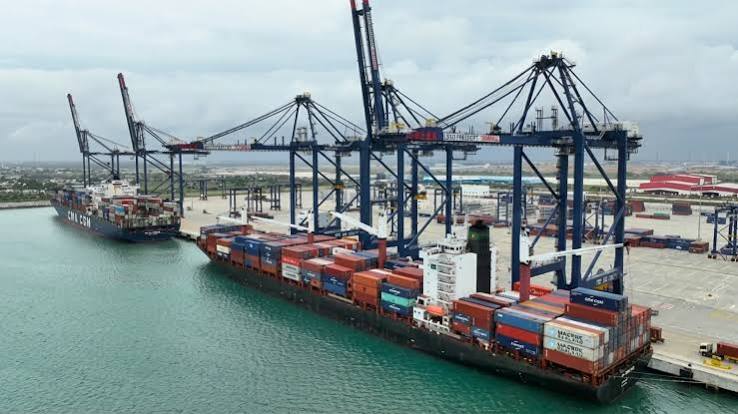
President Bola Tinubu has flagged off the construction of the Bakassi Deep Seaport in Cross River State, describing the project as a major step towards diversifying Nigeria’s economy, expanding maritime trade and creating employment opportunities.
The President, represented by Vice-President Kashim Shettima, performed the groundbreaking ceremony in Bakassi on Friday, November 13, 2026.
Tinubu said the project would open new commercial corridors, stimulate industrialisation and strengthen Nigeria’s capacity to attract a larger share of regional and international maritime trade.
Designed with a 20-metre draft to accommodate large vessels, the proposed port is expected to attract ships that currently bypass Nigerian ports and utilise facilities in neighbouring countries.
The facility will also be connected to a 260-kilometre superhighway intended to facilitate cargo transportation to different parts of the country.
The President recalled that the project was conceived in 2014, with an Environmental and Social Impact Assessment developed in March 2015, before receiving renewed attention under Governor Bassey Otu.
He commended the governor for sustaining the project despite institutional, financial and administrative challenges, including efforts to secure a $3.5bn financing arrangement with the African Export-Import Bank.
“This is beyond a Cross River dream. It is a Nigerian project. It is a poverty breaker,” Tinubu said.
He explained that the Bakassi port would complement existing maritime facilities in Lagos rather than compete with them, noting that Lagos currently handles more than 80 per cent of Nigeria’s foreign trade.
“Lagos is not our enemy. Lagos is our elder brother in trade. No country eats with one hand. No country carries all its loads on one shoulder. That shoulder will break,” he said.
According to the President, developing another major maritime gateway would ease congestion at Lagos ports, reduce transportation costs and improve the country’s competitiveness in regional commerce.
“When Calabar works, Nigeria works on two legs,” he added.
Tinubu observed that Nigeria had yet to fully exploit its extensive coastline along the Gulf of Guinea, despite the enormous opportunities available in maritime transportation and international trade.
He said the Bakassi project would help retain cargo that would otherwise be handled by ports in neighbouring countries while improving Nigeria’s access to international markets.
Governor Otu said the groundbreaking followed years of political, administrative, legal and environmental challenges that had delayed the project.
He credited the Federal Government’s support with helping Cross River secure the necessary approvals, including the Certificate of Compliance and final federal authorisation.
The governor disclosed that the project would be executed through a Public-Private Partnership arrangement, with an initial funding approval of $2.27bn.
He said preparatory activities, including environmental impact assessments, hydrographic, geotechnical and geophysical surveys, had been completed.
Otu identified logistics, shipping, fishing, tourism and shipbuilding as some of the sectors expected to benefit from the development.
He also disclosed that selected indigenes of the state were undergoing specialised training to prepare them for construction and operational opportunities.
The governor further identified the proposed airport, the seaport and the Lagos-Calabar Coastal Highway as components of a broader economic corridor expected to attract investment and accelerate development across the region.
Minister of Marine and Blue Economy, Gboyega Oyetola, also described the project as an important investment in Nigeria’s maritime future.
He disclosed that revenue generated by agencies under the ministry increased from N700.79bn in 2023 to N1.83tn in 2025, attributing the growth to improved revenue collection and the closure of leakages.
Oyetola added that the Federal Government remained committed to modernising the country’s maritime infrastructure and improving the efficiency of its ports.