




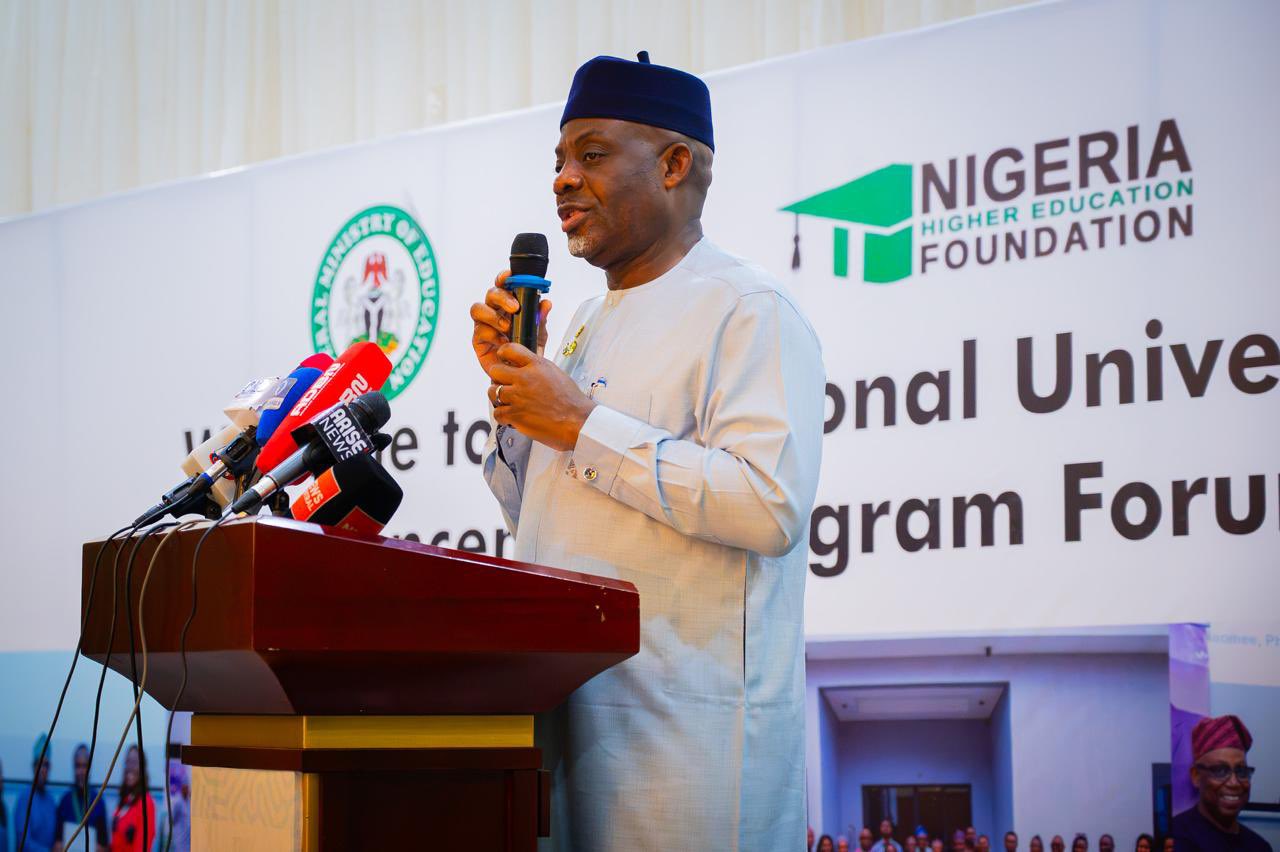
The Federal Government has directed Vice Chancellors of federal universities to rebuild and properly staff their Advancement Offices as part of efforts to diversify funding and reduce reliance on government subvention.
The Minister of Education, Dr Maruf Alausa, gave the directive at the Nigeria Higher Education Foundation National University Advancement Programme Forum, where he expressed disappointment over the low participation of Vice Chancellors in the initiative.
Alausa said only 18 Vice Chancellors attended the forum physically, while just 30 of the 78 federal universities initially participated in the Federal Ministry of Education-NHEF Advancement Programme.
He described the development as unacceptable, stressing that strengthening university advancement structures was critical to the financial sustainability and future development of Nigerian universities.
“For something this important to the future and financial sustainability of our universities, we must do better,” the minister said.
Alausa said he had, since assuming office, urged universities to strengthen their Advancement Offices and explore alternative sources of funding, noting that government resources alone could not sustain the institutions.
“The truth is: no university can survive on government funding alone,” he said.
According to him, universities have significant opportunities to generate additional resources through alumni networks, research grants, philanthropy, endowment funds and partnerships with the private sector.
He, however, lamented that many institutions had failed to prioritise the structures required to identify and maximise such opportunities.
The minister therefore directed Vice Chancellors to rebuild and adequately staff their Advancement Offices and ensure that the units report directly to their offices.
“Place them directly under the Office of the Vice Chancellor. Give your advancement professionals the stability, access and support they need, and fully utilise the training and platform being provided by NHEF,” Alausa said.
He stressed that the directive was mandatory and should no longer be treated as a recommendation.
“This is no longer a suggestion. It is a mandate,” he declared.
The minister said President Bola Tinubu’s administration remained committed to funding education but added that university managers also had a responsibility to develop sustainable alternative sources of revenue.
“President @officialABAT, GCFR, has made it clear that this administration will not renege on its commitment to education. However, finding new sources of funding is also part of the responsibility of every Vice Chancellor,” he said.
Alausa advocated blended financing as a pathway to greater financial autonomy for Nigerian universities, listing research grants, alumni contributions, philanthropy, private-sector investments and endowment funds among the viable options.
“Blended financing is the way forward. Research grants. Alumni. Philanthropy. Private-sector investment. Endowment funds. This is the path towards greater university autonomy,” he said.
The minister said Nigeria could draw from successful international models and adapt them to the country’s higher education system rather than starting from scratch.
“We are not reinventing the wheel. We will take what works globally, adapt it to Nigeria and build institutions that can thrive for generations,” he said.
He commended the Founder and Chief Executive Officer of Kuramo Capital Management, Mr Wale Adeosun, and the NHEF team for their continued partnership with the Federal Ministry of Education and their efforts to re-establish and strengthen Advancement Offices across federal universities.
Alausa charged Vice Chancellors to take ownership of the process, saying universities must move away from the culture of relying solely on government funding.
“The era of waiting for government to fund everything must end. Build the structures. Mobilise the resources. Strengthen your institutions. That is your responsibility, and it must become part of your legacy,” he said.