




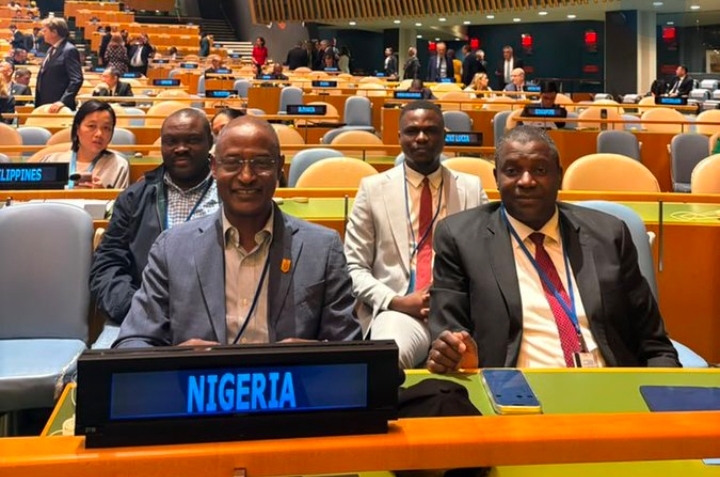
Nigeria has called for stronger international cooperation to reduce road traffic deaths and injuries by 50 per cent before 2030, while unveiling plans to strengthen safety standards for compressed natural gas (CNG) and electric vehicles as part of ongoing reforms in the transportation sector.
The call was made at the United Nations High-Level Meeting on Improving Global Road Safety currently holding at the UN General Assembly Headquarters in New York, United States, where President Bola Tinubu mandated the Corps Marshal of the Federal Road Safety Corps (FRSC), Shehu Mohammed, to lead Nigeria’s delegation.
Presenting Nigeria’s national statement during the plenary session, Mohammed reaffirmed the country’s commitment to advancing road safety through stronger governance, strategic investments, innovation and international partnerships in line with the administration’s Renewed Hope Agenda.
The meeting, which brought together heads of state, ministers, policymakers and road safety experts from across the world, is focused on accelerating efforts to achieve the United Nations target of halving road traffic deaths and injuries by 2030 under the Decade of Action for Road Safety.
Mohammed told delegates that Nigeria had made significant progress in strengthening road safety through reforms aimed at improving enforcement, emergency response and public awareness.
“The Federal Government has continued to strengthen the institutional capacity of the Federal Road Safety Corps through strategic reforms, deployment of technology-driven enforcement systems, improved emergency response mechanisms and enhanced public enlightenment programmes aimed at reducing fatalities on Nigerian roads,” he said.
The FRSC boss also highlighted Nigeria’s efforts to align its transportation sector with global sustainability goals through the Presidential Initiative on Compressed Natural Gas and the adoption of electric vehicles.
According to him, the government is developing safety standards for heavy-duty vehicles, CNG-powered vehicles and emerging transport technologies to ensure that the transition to cleaner energy does not compromise road safety.
He further disclosed that Nigeria recently launched the Nigeria Road Assessment Programme (NigeriaRAP) in collaboration with the International Road Assessment Programme (iRAP) to improve road infrastructure safety using globally recognised safety standards.
Mohammed said the initiative reflects Nigeria’s commitment to the “Safe System Approach” aimed at reducing road crashes and protecting road users.
The Corps Marshal also highlighted Nigeria’s growing leadership role in road safety on the African continent, noting that the country hosts the Secretariat of the African Association of Road Safety Lead Agencies (AARSLA), a platform established to strengthen collaboration and knowledge sharing among road safety institutions across Africa.
While acknowledging progress made so far, he stressed that developing countries still require greater international support to achieve global road safety targets.
“Greater international cooperation remains essential in areas such as intelligent enforcement technologies, road infrastructure safety assessment, institutional capacity development and technology transfer,” Mohammed said.
He called on development partners and the international community to deepen technical cooperation and support capacity-building initiatives aimed at reducing road fatalities worldwide.
Reaffirming Nigeria’s position, the FRSC Corps Marshal declared that road safety remains a major policy priority of the Tinubu administration.
“Road safety remains a national political priority under the administration of President Bola Ahmed Tinubu, and Nigeria will continue to work closely with international partners to build safer roads, save lives and contribute meaningfully to the achievement of the Sustainable Development Goals,” he said.
The United Nations meeting, convened by the President of the UN General Assembly in collaboration with the World Health Organisation (WHO), is expected to adopt a Progress Declaration that will guide global efforts towards reducing road traffic deaths and injuries over the next five years.